Evacuation of Petersburg
In Washington city, the loyal people gathered in a great throng and visited Mr. Seward, the Secretary of State. They called for a speech, when he appeared and said: "I am now about writing my foreign despatches. What shall I tell the Emperor of China? I shall thank him, in your name, for never having permitted a piratical flag to enter a harbor of the empire. What shall I say to the Sultan of Turkey? I shall thank him for always having surrendered rebel insurgents who have taken refuge in his kingdom. What shall I say to the Emperor of the French? I shall say to him that he can go to Richmond to-morrow and get his tobacco, so long held under blockade there, provided the rebels have not used it up. To Lord John Russell, I will say, the British merchants will find the cotton exported from our ports, under treaty with the United States, cheaper than cotton obtained by running the blockade. As for Earl Russell himself, I need not tell him that this is a war for freedom and national independence, and the rights of human nature, and not a war for empire; and if Great Britain should only be just to the United States, Canada will remain undisturbed by us, so long as she prefers the authority of the noble Queen to voluntary incorporation in the United States. What shall I tell the King of Prussia? I will tell him that the Germans have been faithful to the standard of the Union, as his excellent minister, Baron Gerolt, has been constant in his friendship to the United States during his long residence in this country. To the Emperor of Austria, I shall say that he has proved himself a very wise man, for he told us at the beginning, that he had no sympathy with the rebels anywhere." In these few words, Secretary Seward revealed the fact that while Great Britain and France--Christian nations--were assisting the enemies of our Republic to destroy it, Pagan China and Mohammedan Turkey, animated by principles of right and justice, were its abiding friends.
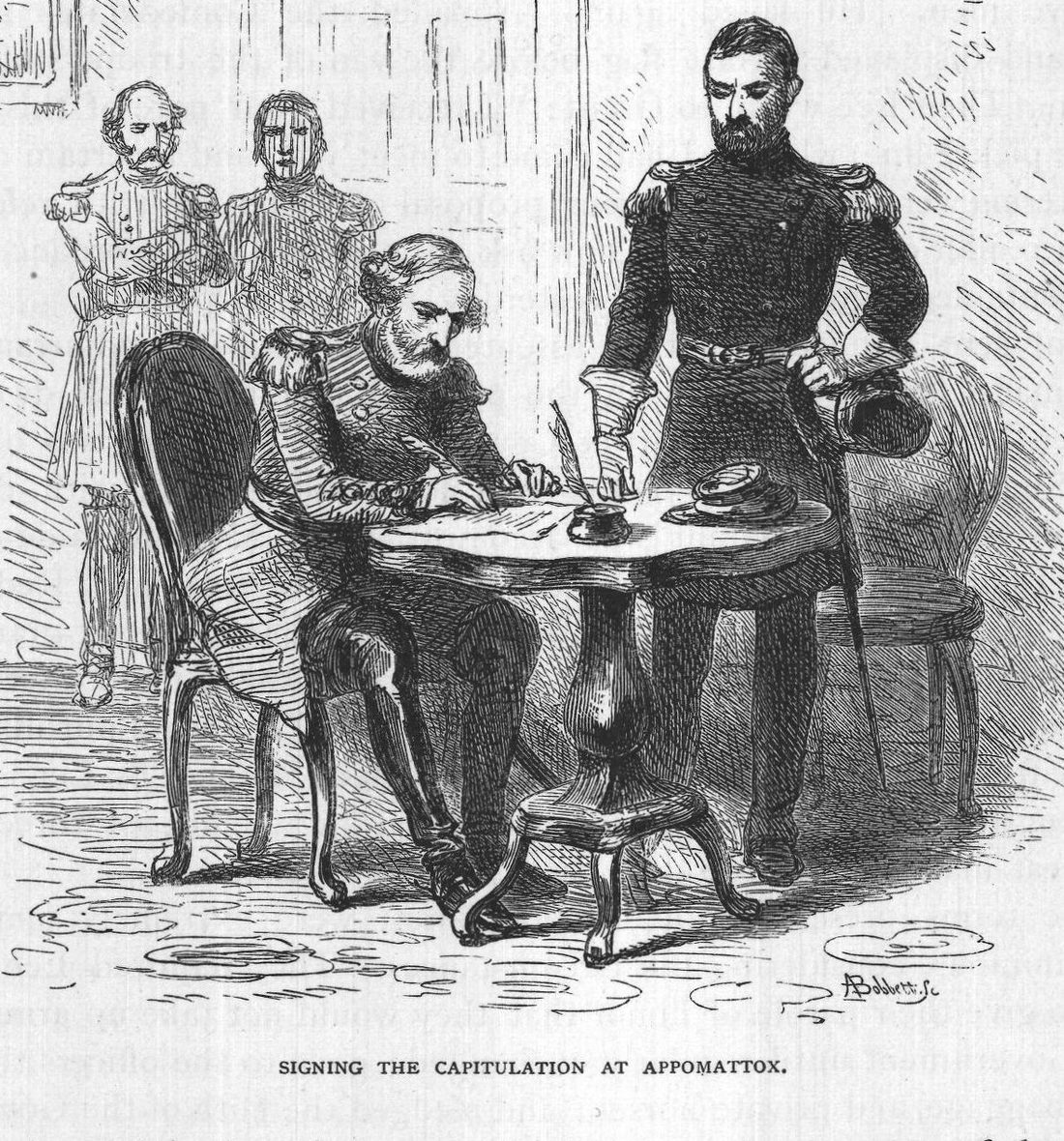
Lee, after he had advised the evacuation of Richmond, perceiving that he could no longer hold Petersburg, abandoned it. He stole away so silently on the evening of the 2d, that the suspicions of the Union pickets were not awakened; and when, at dawn, it was discovered that the intrenchments of the Confederates in front of Petersburg had been abandoned, Lee's army were miles away to the westward, seeking to join the columns at Richmond, in a flight for safety. Lee concentrated his broken army at Amelia Court-House, where they might reach the Danville Railway. He had ordered stores to be sent from Danville to that point for the use of his army; but when, on Sunday afternoon, the loaded trains reached Amelia Court-House, a despatch reached the officer in charge, directing him to continue the train on to Richmond for the transportation of the "government" and the archives. The stupid officer did not leave the supplies at Amelia, but took them on to Richmond, and they were there destroyed in the conflagration. This was a fatal mistake; and when Lee reached Amelia Court-House, with his half-famished army, and found no supplies there, hope forsook him, for his plans were thwarted. He could not move on for want of provisions and forage; and in the meantime, Sheridan gained a position between the Confederates and Lee's avenue of escape. For several days the latter made desperate efforts to break through the National line, cavalry and infantry, that stood across his path, but failed. Finally, on the 9th of April, he made overtures for capitulation.
On the 7th, Grant had written a note to Lee, suggesting that the events of the past week should convince him of the hopelessness of further resistance on the part of the Army of Northern Virginia. "I feel that it is so," Grant wrote, "and regard it as my duty to shift from myself the responsibility of any further effusion of blood by asking of you the surrender of that portion of the Confederate States army known as the Army of Northern Virginia." To this, Lee replied, that he did not believe further resistance would be vain; but reciprocating Grant's desire to avoid useless effusion of blood, he said: "Before considering your proposition, I ask the terms you will offer on condition of its surrender." After dispatching his reply to Grant, Lee resumed his march westward toward Lynchburg, under cover of the darkness. He hoped to escape to the shelter of the mountains beyond Lynchburg. So silent was his retreat, that it was not discovered until the morning of the 8th, when the National army pushed on in pursuit of the fugitives.
On receiving Lee's answer, the lieutenant-general replied: "There is but one condition I would insist upon, namely, that the men and officers surrendered shall be disqualified for taking up arms against the Government of the United States, until properly exchanged;" and he proposed to meet Lee in person, or to delegate officers for the purpose of definitely arranging the terms of surrender.