Effects of the Victory
The victory for the Americans was complete. It would have been more decisive had the co-operating parties been able to perform their duties. They could not; and Washington won all the glory of the victory which greatly inspirited the patriots. In the engagements the Americans did not lose a single man, and had only two--William Washington (afterward distinguished in the South) and James Monroe (afterward President of the United States)--who were slightly wounded. The spoils of victory were almost a thousand prisoners, twelve hundred small arms, six brass field-pieces, and all the German standards. The triumphant army re-crossed the Delaware at McConkey's Ferry, and before midnight of the day of victory were back to their encampment.
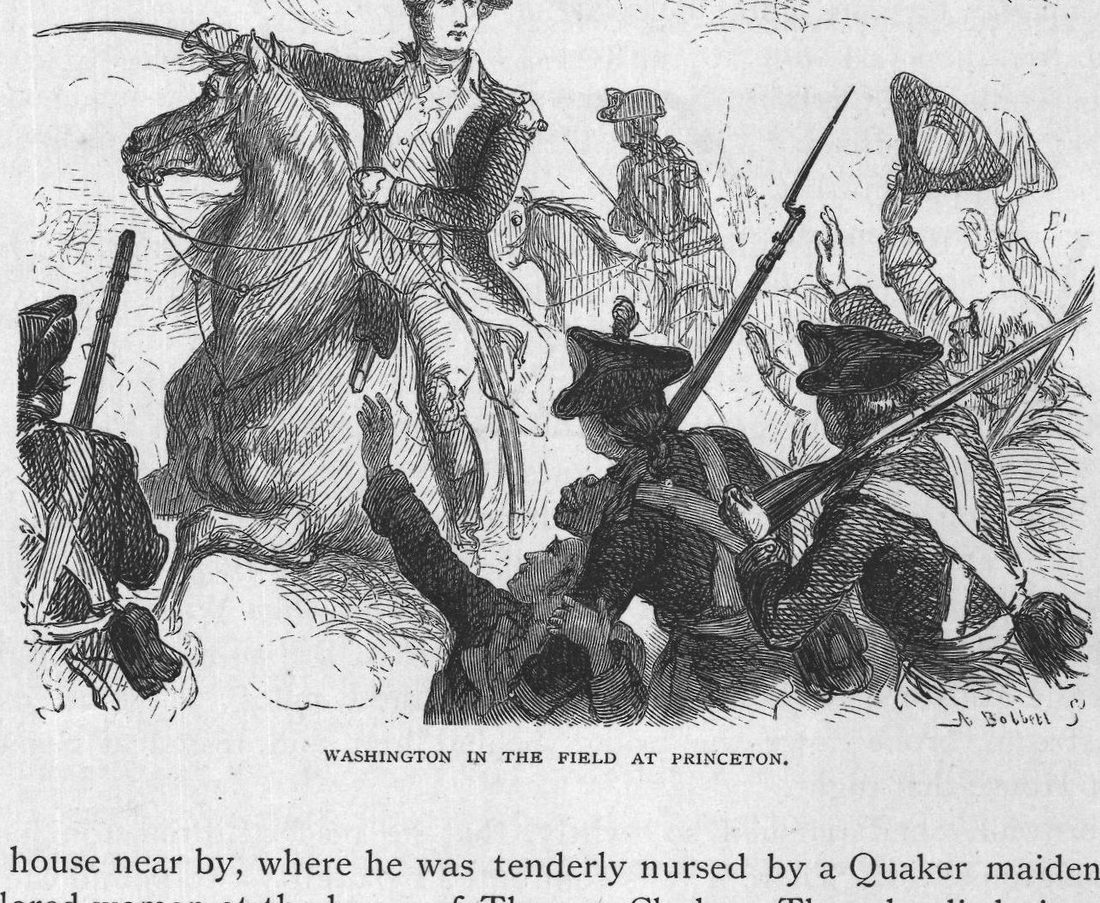
This bold stroke of the American general puzzled and amazed the British leaders, alarmed the Tories, and dissipated the terror which had been felt in the presence of the Hessians, as invincible troops. The faltering militia soon flocked to the standard of Washington, and many of the soldiers, who were about to leave the American camp, re-enlisted. Cornwallis was sent back to New Brunswick, where General Grant was in command of the main British army in New Jersey, and the other cantonments in that province were broken up and the troops concentrated toward Trenton. Grant moved forward to Princeton, and Washington, who had resolved to attempt to drive the British out of New Jersey, boldly recrossed the river to the eastern side, and took post with his army at Trenton, on the 30th of December, 1776. The Congress, sitting at Baltimore, had invested him with powers almost equal to those of a Roman Dictator, for six months, authorizing him to reorganize his army; appoint all officers below brigadier-general; to make requisitions for subsistence and enforce them with arms, and to arrest the disaffected. Intending to remain on the eastern side of the Delaware, he announced to the Congress, while his army was crossing that stream, his intention "to pursue the enemy and try to beat up their quarters;" and he directed McDougall and Maxwell to collect troops at Morristown, as a place of refuge in case he should need one.
The low condition of the military chest would not allow Washington to pay the bounties agreed to be given, at the appointed time, and the commander-in-chief wrote to Robert Morris, the great financier of the Revolutionary period, for an immediate supply of hard money. The Congress had just resolved to issue bills to the amount of five million dollars immediately, but the credit of that body was then very low, even John Dickenson refusing to take the Continental money. The credit of Robert Morris was high, and confidence in him was unbounded. The sum asked for was large, and the financier was perplexed with doubts of his ability to obtain it. In a despondent mood he left his counting-room at a late hour, musing, as he walked in the street, on the subject of the requisition, when he met a wealthy member of the Society of Friends, who, at that time, were generally of the Tory faith in politics. To this Friend, Morris made known his wants. "Robert, what security canst thou give?" asked the Quaker. "My note and my honor," Morris replied. "Thou shalt have it," the Friend answered, and the next day Morris wrote to Washington: "I was up early this morning to dispatch a supply of fifty thousand dollars to your Excellency." Washington, in acknowledging its receipt, wrote that he had engaged a number of the eastern troops to stay six weeks beyond their term of enlistment, upon giving a bounty of ten dollars. "This, I know," wrote Washington, "is a most extravagant price when compared with the time of service;" but he thought it "no time to stand upon trifles."
The main army of Americans, about five thousand strong, were encamped on the south side of the Assanpink Creek at Trenton, when, toward evening on the 2d of January (1777), Cornwallis approached from Princeton with a superior force of British regulars. They had engaged in a series of skirmishes on the way, and followed the Americans, who had attacked them, to the margin of the Assanpink. After trying to pass the guarded fords of that stream, they halted and lighted fires; and Cornwallis rested that night with the full assurance that he would make an easy conquest of the republican army the next day. "I will catch the fox in the morning," said the Earl to Sir William Erskine, who urged him to make an attack that night.