Effect of the Surrender of Cornwallis, in Europe: Washington
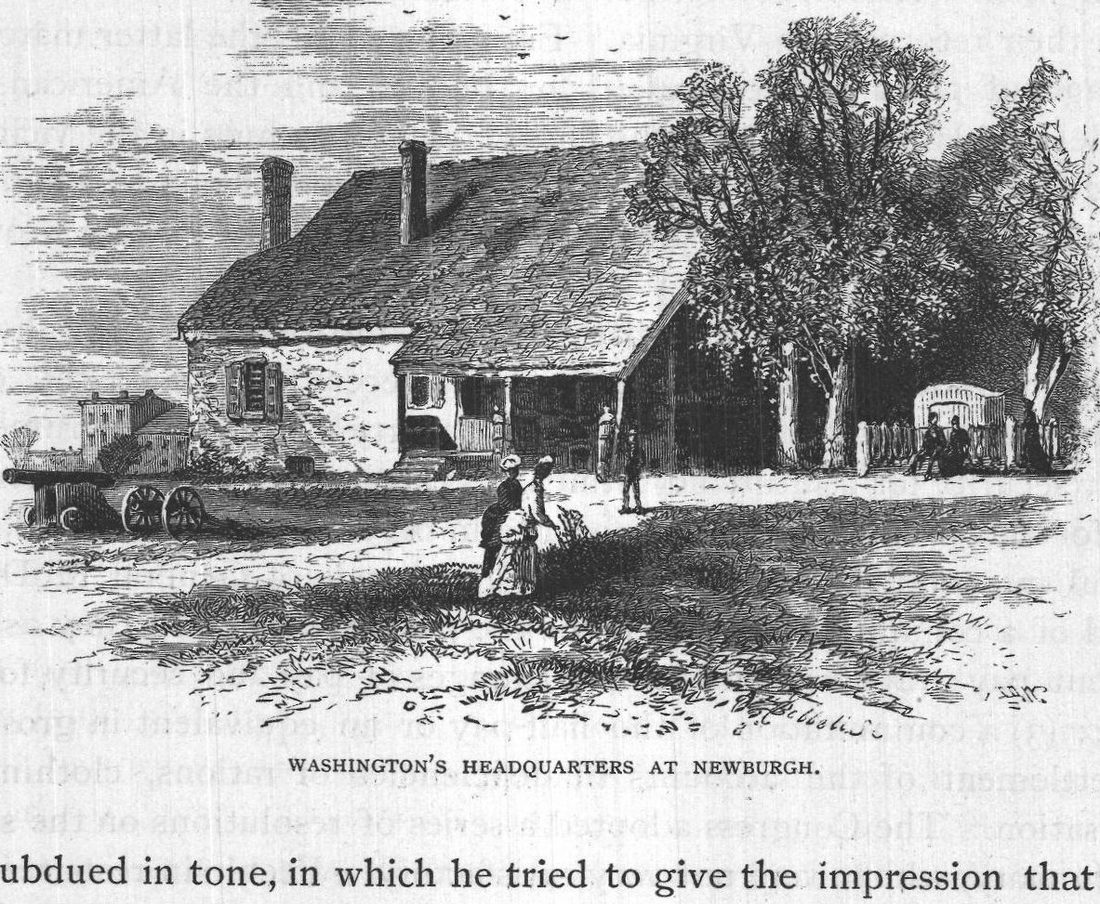
Many months later discontents in the army assumed a more dangerous form. The headquarters of the army had been, during the autumn of 1782, at Verplanck's Point, on the Hudson, when the troops numbered about ten thousand men. There they formed a promised junction with the French army on their return from Virginia. From that point the latter marched to New England ports and embarked for France, and the Americans went above the Highlands and spent the ensuing winter in huts in the vicinity of Newburgh. At the latter place Washington made his quarters in a house yet standing in the southern portion of that rural city, on the brow of a slope extending to the river.
In the latter part of the winter of 1783, the discontent in the army appeared more formidable than ever. In December (1782), the officers seeing in the continued weakness and poverty of their government no apparent security for a future adjustment of the claims of the army for backpay or for the promised half-pay for a term of years for themselves, sent a respectful memorial to the Congress by the hands of General McDougall, the head of a committee appointed for the purpose, in which they asked (1) for present pay; (2) a settlement of arrearages of pay and security for what was due; (3) a commutation of the half-pay or an equivalent in gross; and (4) a settlement of the accounts of deficiencies of rations, clothing, and compensation. The Congress adopted a series of resolutions on the subject, late in January, which were not very satisfactory. Feeble in resources, they made no definite promises of present relief or future justice, and the discontents of the army were greater than before. Early in March a well-written address to the army was circulated extensively through the camps. If bore no name of author, but was calculated to stir up the spirit of revolt in the hearts of the soldiers. It advised the army to take matters into their own hands, make demonstrations of power and determination that should arouse the fears of the people and of the Congress, and so obtain justice for themselves. With this address was circulated privately a notification of a meeting of officers at a large building called The Temple, which had been erected for public meetings and a gathering-place for the Freemasons of the army.
These papers were brought to the notice of Washington on the day when they were issued, and he determined to guide and control the movement. In general orders the next morning he referred to them; expressed his disapprobation of the whole proceedings as disorderly, and requested the general and field officers, with one officer from every company in the army, to meet at the "New Building" (The Temple) on the 15th at noon. General Gates, the senior officer, was requested to preside. On the appearance of this order, the writer of the anonymous addresses issued another, more subdued in tone, in which he tried to give the impression that Washington approved the scheme, the time of meeting being changed. There was a full attendance, and deep solemnity pervaded the assembly, when the commander-in-chief stepped upon the platform to read an address which he had prepared for the occasion. As he put on his spectacles, he remarked: "You see, gentlemen, that I have not only grown gray, but blind in your service." This simple remark, under the circumstances, had a powerful effect upon the assemblage. When he had read his address, so compact in form and construction, so clear in expression and meaning, so dignified and patriotic, so mild yet so severe, and withal so vitally important in its relations to the well-being of the unfolding republic, the men before him and the army they represented, as well as the best interests of human freedom, he immediately retired and left the officers to discuss the matter unrestrained by his presence. Their conference was brief; their deliberations, short. They passed resolutions by unanimous vote thanking their chief for the course he had pursued; expressing their unabated attachment to his person and their country; declaring their unshaken confidence in the good faith of Congress, and their determination to bear with patience their grievances until, in due time, they should be redressed. These proceedings were signed by General Gates as president of the meeting; and three days afterward Washington, in general orders, expressed his entire satisfaction. All the papers relating to this affair were forwarded to the Congress and entered at length in their journals; and very soon that body took action that satisfied the army of the wisdom of Washington's proceedings at Newburg. The author of the anonymous addresses was Major John Armstrong, one of General Gates' aids, who afterward held civil offices of distinction in our national government. He was Secretary of War during a portion of the conflict between the United States and Great Britain in 1812-'15. In a letter to Armstrong many years after the events above related, Washington expressed his belief that the motives of the major were patriotic.