Disturbances in the South
With General Custer perished two of his brothers, a brother-in-law, and other gallant officers. Many of them had doubtless been murdered after they had been captured, and their bodies were horribly mutilated. The body of the general was afterward found the fully identified. It was taken to Fort Abraham Lincoln, in Dakota Territory, where provision was made for its conveyance to West Point, on the Hudson River, for interment. It was at first sent to Poughkeepsie, at midsummer, 1877, and deposited in the receiving vault of the Rural Cemetery there, where it remained until the 10th of October following, when it was conveyed to West Point, with a certificate from the post-surgeon of Fort Lincoln, that the burial casket contained "the remains of General George A. Custer, lieutenant-colonel Seventh cavalry, killed at the battle of Big Horn River, June 25, 1876." The casket containing the remains was escorted to the steamboat that conveyed it to West Point, by Poughkeepsie military, followed by the mayor and common council of that city, and large number of citizens in carriages and on foot. It was received at West Point by a guard of honor, and buried with imposing ceremonies, religious and military.
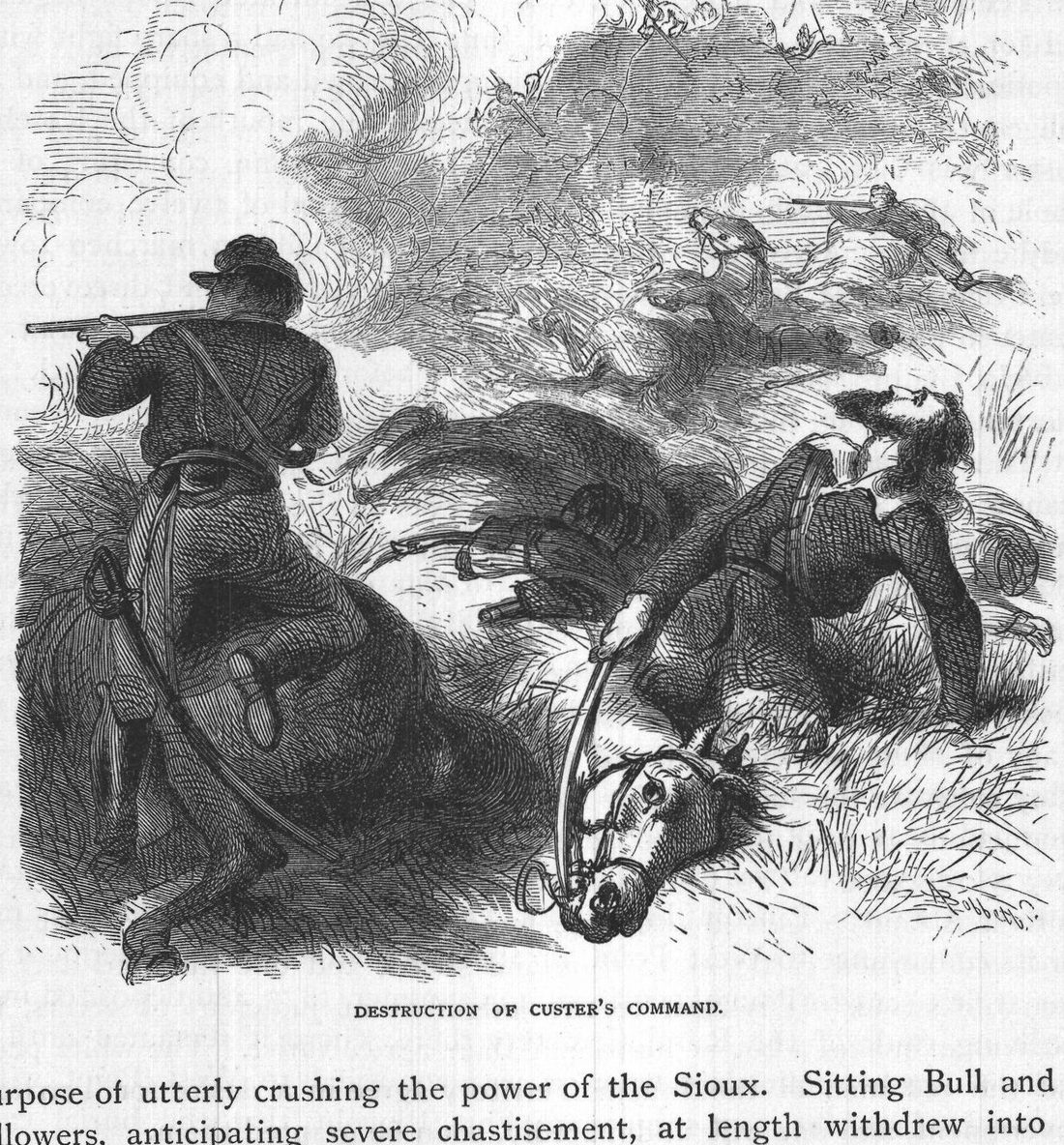
The news of the destruction of Custer and his command produced much excitement throughout the country; and the Government immediately ordered a large military force into the region of the Black Hills, for the purpose of utterly crushing the power of the Sioux. Sitting Bull and his followers, anticipating severe chastisement, at length withdrew into the British possessions, where they yet remained at the time this record was made--November, 1877.
We have alluded to the fact that the Territory of Colorado had to wait for admission into the Union as a State, ten years after first making application for the privilege. That act was consummated on the 4th of July, 1876, by a decision of Congress, and was the crowning achievement in our national growth at the end of the first century of the political existence of the Republic. By that act it was made to comprise thirty-eight independent States within its sovereign control. There are, also, ten Territories besides, each making rapid progress in population and the development of its resources. All are preparing for admission into the Union as States, at a time not distant in the future. Two bounded domains, namely, the Indian Territory and Alaska, have not yet secured Territorial governments, with chief magistrates, and legislatures, and with representatives in Congress.
Alaska is a large domain, lying in the extreme northwestern portion of the North American Continent, and separated from the States and Territories by British possessions. It was purchased from Russia, in 1867, for the sum of $7,200,000 in gold. Its seal and other fisheries, and timber, are very valuable. According to official reports, in 1873, the "Alaska Commercial Company" of San Francisco, supply eighty per cent. of the fur of seals killed, in the world, and therefore have a virtual monopoly of that trade; and in 1870, the product of other fisheries was large. In salted codfish alone it was ten million six hundred and ten thousand pounds.
The Indian Territory lies west of Arkansas and Missouri, between Kansas and Colorado on the north, and Texas on the south, and with Texas and New Mexico on its western borders. In 1870, it contained a population of about sixty thousand Indians, twenty-four thousand white people, and between six and seven thousand colored people. It comprises seventeen Indian reservations, upon which are settled as the principal nations of the dusky occupants, Cherokees, Creeks, Choctaws, Chickasaws, and Seminoles. Many of these are civilized, and are following the pursuits of civilization. They cultivate the soil and raise live-stock. The value of their agricultural productions is over $5,000,000, annually; and of their live-stock, in 1875, over $10,000,000. The Choctaws, who have about fifty thousand acres of cultivated land, possessed over one hundred thousand horses, one hundred thousand horned cattle, eight thousand sheep, and one hundred and fifty thousand swine. It is clear to the judgment of judicious observers, that the Indian makes a better herdsman than agriculturist. The white people and the red men of the Indian Territory agree in a desire for Territorial government, and one will, undoubtedly, soon be granted them.