Disruption of the Democratic Party
The debate upon these reports was opened by the chairman of the majority committee (Mr. Avery of North Carolina), who assured the Convention that if the doctrine of Popular Sovereignty should be adopted as the doctrine of the Democratic party, the members of the Convention from the slave-labor States and their constituents, would consider it as dangerous and subversive of their rights, as the adoption of the principle of Congressional interference or prohibition. The debate continued until the 29th (April, 1860), and on the morning of the 30th the vote was taken in the presence of an immense audience with which the hall was packed. Mr. Butler's report was first acted upon, and rejected. Then the minority report was presented by Mr. Samuels of Iowa, and adopted by a decided majority. Preconcerted rebellion immediately lifted its head, and the delegates from Alabama, led by L. Pope Walker (afterward the Confederate Secretary of War), seceded and left the Convention. This secession was followed by delegates from the other slave-labor States, and they all reassembled at St. Andrew's Hall to prepare for an independent political organization. The disruption of the Democratic party represented in the Convention was now complete. The slavery question had split it beyond hope of restoration; an event which had been provided for, in secret, by the politicians. When D. G. Glenn, of the Mississippi delegation, announced the secession of the representatives from that State, he said: "I tell Southern members, and, for them, I tell the North, that in less than sixty days you will find a united South standing side by side with us." These utterances called forth long and vehement cheering, especially from the South Carolinians; and that night Charleston was the theatre of great rejoicings, for the leaders there comprehended the significance of the movement.
On the following day, the seceders, with James A. Bayard of Delaware at their head, organized what they called a "Constitutional Convention;" sneered at the body they had left, as a "Rump Convention," and on the 3d of May adjourned to meet in Richmond, Virginia, in June. The regular Convention also adjourned, without making a nomination, to meet at Baltimore on the 18th of June.
The seceders reassembled in Richmond on the 11th of June. Robert Toombs and other Congressmen had issued an address from Washington city, urging the Richmond Convention to refrain from all important action there, but to adjourn to Baltimore, and there re-enter the Convention from which they had withdrawn, and, if possible, defeat the nomination of Mr. Douglas. This high-handed measure was resorted to; and when the Richmond convention adjourned, most of the delegates hastened to Baltimore, and claimed the right to re-enter the Convention from which they had formally withdrawn. The South Carolina delegates remained in Richmond to watch the course of events and manage the scheme.
At the appointed time the regular Convention assembled at Baltimore, with Mr. Cushing in the chair. The question arose as to the right of the seceders to re-enter the Convention. Some were favorable to their admission; others proposed to admit them provided they would pledge themselves to abide by the decision of the majority. A stirring time ensued, and the matter was referred to a committee, a majority of whom reported in favor of admitting Douglas delegates from the slave-labor States in place of the seceders. In the course of a vehement debate that ensued, a slave-trader from Georgia warmly advocated the policy of reopening the African slave-trade, and his sentiments were loudly applauded. The majority report was adopted, when a large number of delegates from the border slave-labor States withdrew. This was followed the next morning (June 23, 1860) by the withdrawal of Mr. Cushing and a majority of the Massachusetts delegation. "We put our withdrawal before you," Mr. Butler said, "upon the simple ground, among others, that there has been a withdrawal, in fact, of a majority of the States; and further (and that perhaps more personal to myself) upon the ground that I will not sit in a convention where the African slave trade, which is piracy by the laws of my country, is approvingly advocated."
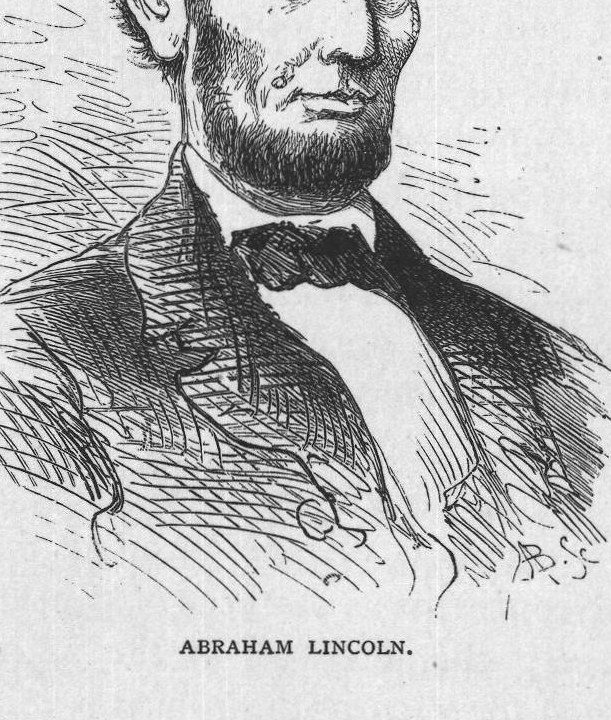
Vice-President Tod, of Ohio, now took Mr. Cushing's place at the head of the Convention, which proceeded to nominate Stephen A. Douglas, of Illinois, for President by an almost unanimous vote. Herschel V. Johnson of Georgia was afterward nominated for Vice-President. Meanwhile the seceders, young and old, had reassembled, called Mr. Cushing to the chair, denominated their body the National Democratic Convention, and proceeded to nominate John C. Breckenridge of Kentucky for President, and Joseph Lane of Oregon for Vice-President. A recent political organization calling themselves the "National Constitutional Party" had already nominated (May 9, 1860) John Bell of Tennessee for President, and Edward Everett of Massachusetts for Vice-President. A week later (May 16) a vast concourse of Republicans assembled in an immense building erected for the purpose in Chicago, and called the "Wigwam," nominated Abraham Lincoln of Illinois for President, and Hannibal Hamlin of Maine for Vice-President.