Disputes About Fisheries
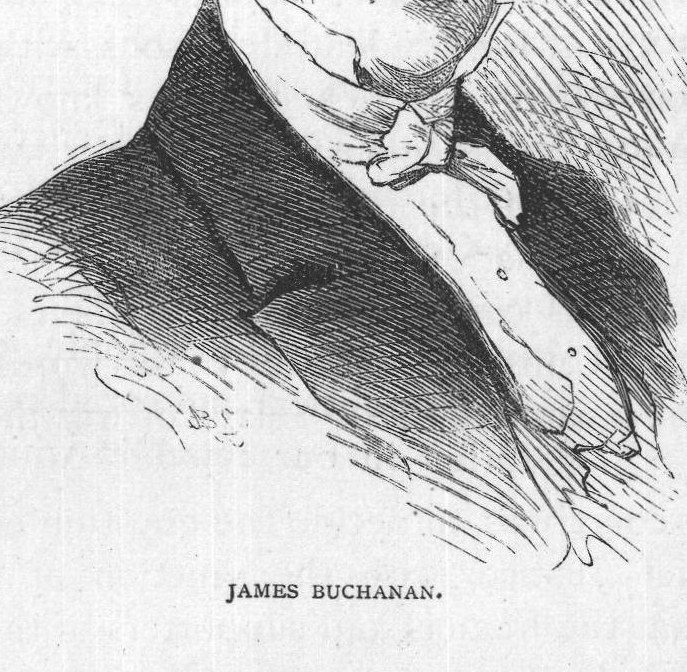
The sympathy manifested by a large portion of the people of the United States in the efforts of Lopez in Cuba, gave rise to suspicions in Europe that it was the policy of our government to ultimately possess that island and assume control over the Gulf of Mexico (the open door to California) and the West India Islands, which were owned chiefly by France and England. To prevent such a result, the governments of these two countries asked that of the United States to enter into a treaty with them, which should secure Cuba to Spain, by agreeing to disclaim "now and forever hereafter, all intention to obtain possession of the Island of Cuba," and "to discountenance all such attempts, to that effect, on the part of any individual or power whatever." To this invitation our Secretary of State (Edward Everett) replied, in the spirit of the "Monroe Doctrine," that the question was an American and not an European one, and not properly within the scope of the interference of European cabinets; that the United States did not intend to violate any existing neutrality laws; that the government claimed the right to act in relation to Cuba independent of any other power, and that it could not see with indifference "the island of Cuba fall into the hands of any other power than Spain." France made no rejoinder; Great Britain did; and so ended the diplomatic correspondence on the proposed "Tripartite Treaty," in February, 1853. In the letter of Lord John Russell, the English prime-minister, there was an intimation that England and France would not see with indifference the possession of Cuba by the United States. The suspicion that our government intended to gain possession of that island was confirmed by the act of its agents abroad, the following year. Mr. Buchanan, Mr. Mason, and Mr. Soule then represented our country, respectively, at the courts of Great Britain, France, and Spain. They met at Ostend, in Belgium, in October, 1854, by direction of President Pierce, to confer upon the best method for settling all difficulties about Cuba and gaining possession of that island. They embodied their views in a letter to our government, in which they recommended the purchase of Cuba, if possible; if not, to obtain it by force. "If Spain," they said, "actuated by stubborn pride and a false sense of honor, should refuse to sell Cuba to the United States," then "by every law human and divine, we shall be justified in wresting it from Spain, if we possess the power." Honest Americans would gladly blot this letter from our national records, for it is justly regarded as one of the most disgraceful passages in the history of American diplomacy.
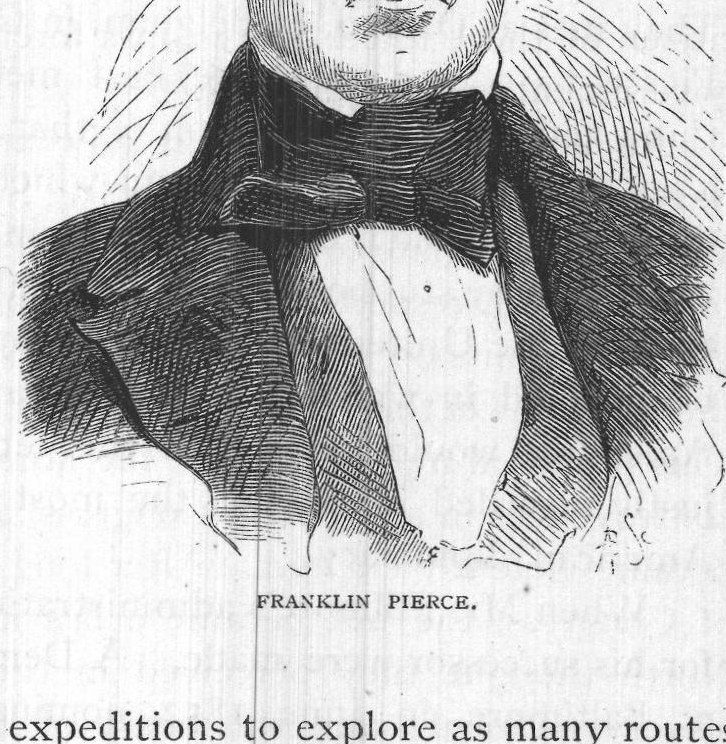
When Mr. Fillmore's administration was drawing to a close, nominations for his successor were made. A Democratic national convention assembled at Baltimore, in June, 1852, nominated General Franklin Pierce of New Hampshire, for President, and William R. King of Alabama, for Vice-President. A Whig national convention assembled at the same place in the same month, and nominated General Winfield Scott for President, and William A. Graham of North Carolina for Vice-President. The Democratic nominees were elected, and on the 4th of March, 1853, President Fillmore retired to private life. One of the most important of the closing events of his administration was the creation, by act of Congress, of a new Territory called Washington, which was carved out of the northern part of Oregon. The bill for this purpose became a law on the 2d of March, 1853.
General Pierce took the oath of office as President of the United States, upon a platform of New Hampshire pine, which had been erected at the eastern portico of the Capitol. It was administered in the presence of thousands of people, who stood in a storm of driving sleet as witnesses of the august ceremony. President Pierce chose for his cabinet William L. Marcy, Secretary of State; James Guthrie, Secretary of the Treasury; Jefferson Davis, Secretary of War; James C. Dobbin, Secretary of the Navy; Robert McClelland, Secretary of the Interior; James Campbell, Postmaster-General, and Caleb Cushing, Attorney-General.
Important American explorations by sea and land, in the interests of commerce, marked the earlier portion of Pierce's administration. The acquisition of California opened the way for an immense commercial interest on our Pacific coast; and in the spring of 1853, Congress sent four armed vessels to the eastern shores of Asia, by way of Cape Horn, to explore the region of the Pacific Ocean, which, it was evident, would soon be traversed by American steamships plying between the ports of our western frontier and Japan and China. At the same time plans were maturing for the construction of a railway across the continent from the Atlantic to the Pacific Ocean. Congress, in the summer of 1853, sent out four surveying expeditions to explore as many routes along the general course of four degrees of latitude. One of these lines of railway, known as the Union Pacific, was completed in the spring of 1869. On a beautiful day in May, in a grassy valley in mid-continent, and in the presence of a great concourse of spectators, the last spike was driven and the great work was completed. Over that railway passengers may now be carried from the Atlantic to the Pacific, in the course of six or seven days.