Davis's Professions
The expedition against the Navy-yard at Gosport was more successful. It was situated on the Elizabeth River, opposite Norfolk, and at that time contained two thousand pieces of heavy cannon fit for service, and a vast amount of munitions of war, naval stores, and materials for ship-building. In the waters near and on the stocks were several vessels-of-war, which the Secessionists attempted to secure by sinking obstructions in the river below to prevent their sailing out. This was done on the day before the Virginia Ordinance of Secession was adopted. The post was in command of Commodore C.S. McCauley, who, soothed and deceived by false professions of loyalty by the officers of Southern birth under him, delayed taking action to protect the Navy-yard and the vessels until it was too late. When the action of the officers at Pensacola was known, these men said to the Commodore, "You have no Pensacola officers here; we will never desert you; we will stand by you until the last, even to the death;" yet these men all resigned when the Virginia Ordinance of Secession was passed, abandoned their flag, and joined the forces under General Taliaferro, commander of the Virginia troops in that region, who arrived at Norfolk on the evening of the 18th of April to attempt the seizure of the naval station. Believing an immediate effort would be made to seize the vessels, McCauley ordered them to be scuttled and sunk, and this was done. At that critical moment, Captain Paulding of the navy arrived in the Pawnee as the successor of McCauley, and perceiving all the vessels but the Cumberland, beyond recovery, he ordered them and all the public property at the Navy-yard to be burned or otherwise destroyed. This destruction was only partially accomplished. About seven million dollars worth of property disappeared; but the insurgents gained a vast number of heavy guns with which they waged war afterward. They also saved some of the vessels. Among the latter was the Merrimac, which was afterward converted by the Confederates into a powerful iron-clad vessel. This important post was held by the insurgents until early in May the following year, when it was recovered by General Wool.
So secretly had the Confederates prepared for the seizure of the National capital, that the sudden development of their strength was amazing. The Government was made painfully aware that its call for troops had not been made an hour too soon. There was a general impression that Washington city was to be the first point of serious attack, and toward it vast numbers of armed men eagerly pressed to the protection of the President, his cabinet, the Government archives, and the Capitol. Within three days after the call, full one hundred thousand young men had dropped their implements of labor to prepare for war.
Those of Massachusetts were first ready. Early in the year Governor Andrew had put the militia of the State on a sort of war footing, and five thousand volunteers were drilled in armories. He invited the other New England States to do likewise, and they complied, in a degree. When, on the day the President called for seventy-five thousand men, Senator Henry Wilson telegraphed to Governor Andrew to send twenty companies immediately to Washington, they were ready. A few hours later the requisition of the Secretary of War reached the governor, and before sunset four regiments at different points were ordered to muster on Boston Common. They were all there the next day, in charge of Brigadier-General Benjamin F. Butler; and it was arranged for the Sixth Regiment, Colonel Jones of Lowell, to go forward at once to Washington, through New York, Philadelphia, and Baltimore.
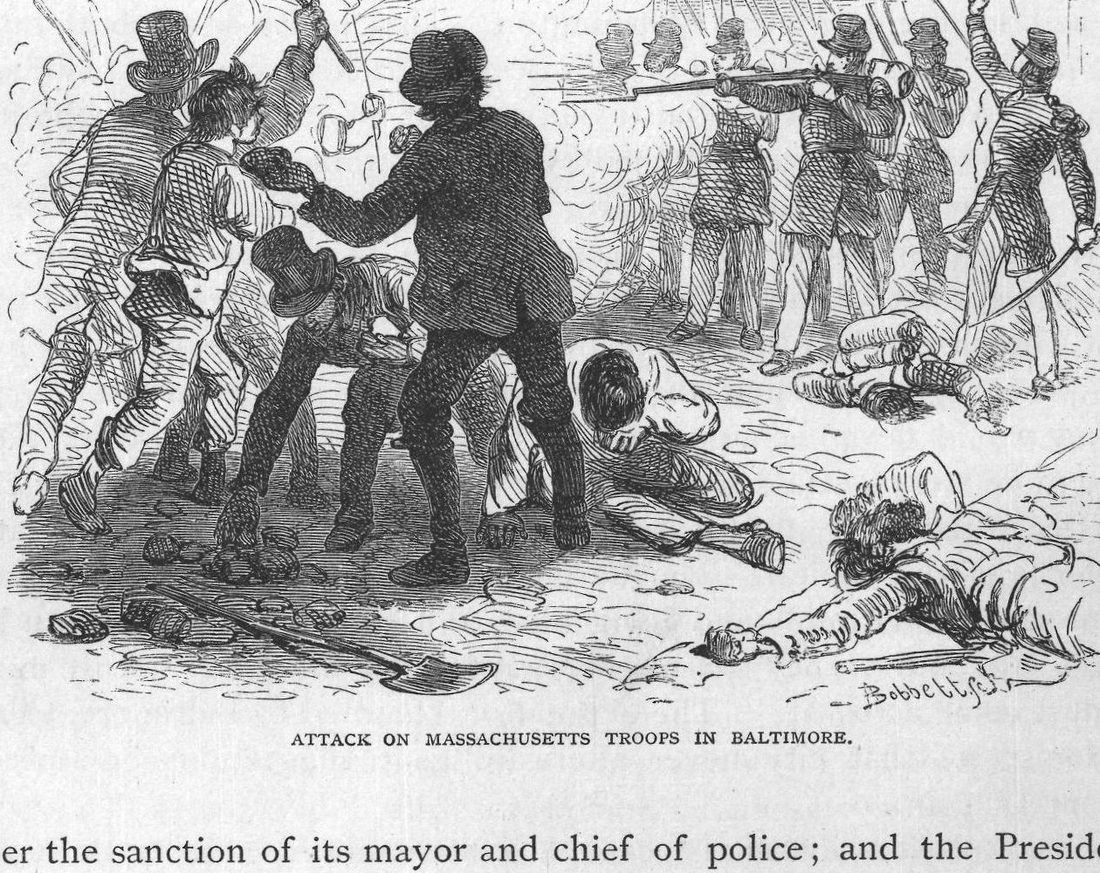
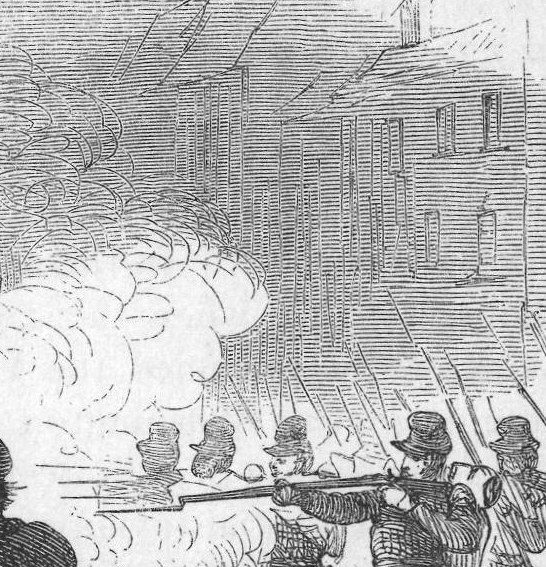
On the day (April 18) when the insurgents expected to seize the arms at Harper's Ferry, five companies of Pennsylvanians passed through Baltimore for the capital. They were slightly attacked by the mob in that city. They were the first of the loyal troops to reach Washington city, and were quartered in the Capitol. The Secessionists of Maryland were then active, and were determined to place their State as a barrier across the pathway of troops from the North and East. Their governor (Hicks) was a loyal man, but the mayor of Baltimore was not, and the chief of police (Kane) was an ally of the disloyal leaders. When the Pennsylvanians had passed through the city, rumors came that a regiment from Massachusetts were approaching; and when, on the following day (April 19, 1861), the latter were marching from one railway station to another, in Baltimore, they were violently assailed with missiles of every sort by an excited populace numbering full ten thousand persons. The mayor, alarmed at the furious whirlwind that his political friends had raised, vainly attempted to control it. With a large body of the police most of whom did not share in the treason of their chief (Kane), he tried to quell the disturbance, but his power was inoperative. The fight in the streets was severe. Three of the troops (the Sixth Massachusetts) were killed or mortally wounded, and in defence of their own lives they slew nine citizens of Baltimore. This tragedy produced intense excitement all over the country. There the first blood was shed in the terrible conflict that ensued. For a moment the indignation of the loyal people was so hot, that the city seemed doomed to swift destruction. A cry went forth, "Lay it in ashes!" and Bayard Taylor wrote:
God's wrath is swift and sure;
The sky with gathering bolts is red.
Cleanse from thy skirts the slaughter shed
Or make thyself an ashen bed,
O Baltimore!"