Cresap and Logan
Early in 1774, the Indians committed many murders and depredations along the Ohio borders, and it was ascertained that the tribes were exchanging belts in seeming preparation for war. At that time Michael Cresap, a settler from Maryland, was near the present Wheeling, engaged in planting a colony. He had had some encounters with the Indians, but was disposed to treat them kindly. Late in April he received a message from Dr. Connolly that an Indian war was inevitable, when Cresap called a council of the settlers. Regarding Connolly's message as a warrant for making war on private account, they declared it against the Indians on the 26th of April. On the following day two canoes, filled with the painted savages, appeared, when they were attacked and pursued far down the river. When the pursuers returned, they proposed an assault upon the settlement of Logan, a Mingo chief, who had been reared near the banks of the Susquehanna, in Pennsylvania, spoke English well, and was a friend of the white people. Cresap prevented the expedition; but other traders, not so discreet, soon raised a furious tempest of resentment against their white brethren. Opposite Logan's settlement (thirty miles above Wheeling) was the cabin of a trader who sold rum to the savages. On one occasion some unarmed Indians, with their women, passed over the river, and all became drunk at the trader's house, when they were all murdered in cold blood by some white people who had been concealed near. Among the slain were the mother, brother, and sister of Logan, the latter the wife of John Gibson, a trader. The spirit of revenge was aroused in great intensity in the bosom of the Mingo chief; and nearly all the ensuing summer he was out upon the war-path gathering a fearful harvest of scalps from the heads of white people as trophies of his valor and vengeance. As Cresap was a leader of the white people on the Ohio, Logan held him responsible for the massacre, though, at that time, the trader was with his family in Maryland. To him Logan sent a note, late in summer, written by William Robinson with ink made of gunpowder, as follows:
"Captain Cresap,--What did you kill my people on Yellow Creek for?
The white people killed my kin at Conestoga, a great while ago, and I thought nothing of that. But you killed my kin again on Yellow Creek, and took my cousin prisoner. Then I thought I must kill too; and I have been three times to war since. But the Indians are not angry--only myself."
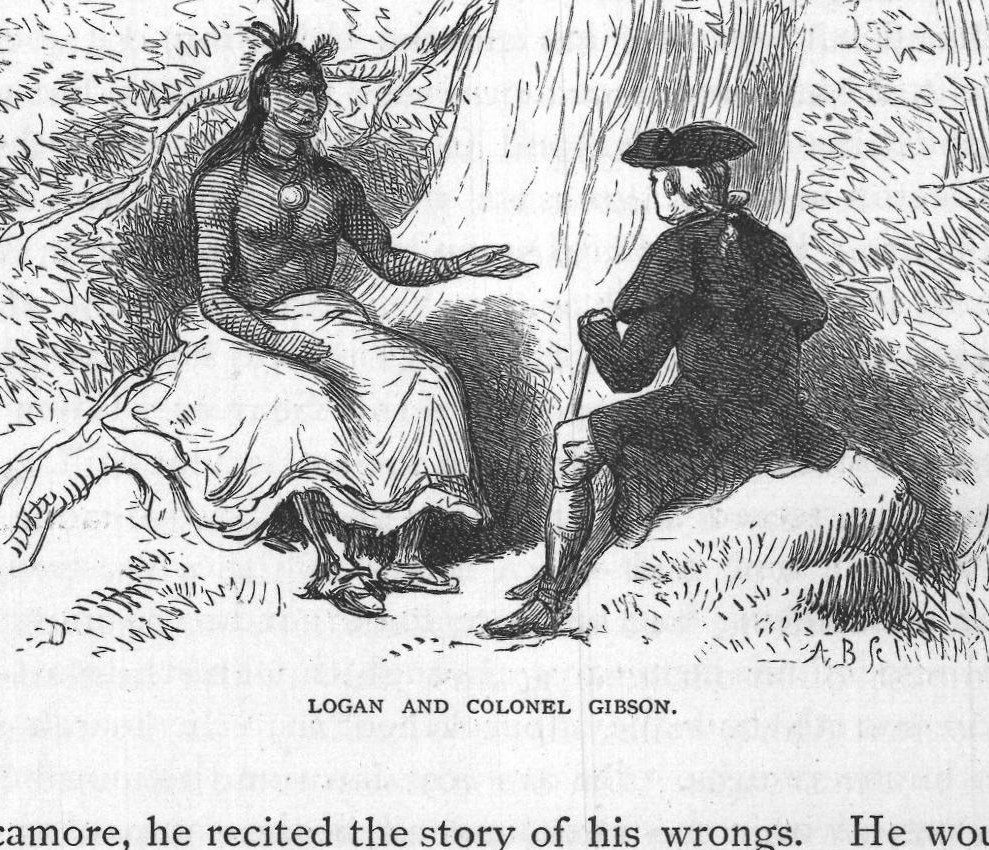
After the war that ensued was over, Logan, then at old Chillicothe, on Pickaway Plains, refused to attend a council to which Lord Dunmore invited him. That invitation was sent by Colonel John Gibson. Logan took the messenger into the woods, where, seated upon a moss-covered root of an immense sycamore, he recited the story of his wrongs. He would not hold council personally with a white man; but he sent the following remarkable speech in the mouth of Colonel Gibson, which the latter wrote down and delivered to Dunmore:
"I appeal to any white man to say, if ever he entered Logan's cabin hungry and he gave him no meat; if ever he came cold and naked and he clothed him not. During the course of the last long and bloody war, Logan remained idle in his cabin, an advocate for peace. Such was my love for the whites, that my countrymen pointed as they passed and said: `Logan is the friend of the white man.' I had even thought to have lived with you, but for the injuries of one man. Colonel Cresap, the last spring, in cold blood, and unprovoked, murdered all the relations of Logan, not even sparing my women and children. This called on me for revenge. I have sought it. I have killed many. I have fully glutted my vengeance. For my country, I rejoice at the beams of peace. But do not harbor a thought that mine is the joy of fear. Logan never felt fear. He will not turn on his heel to save his life. Who is there to mourn for Logan? Not one!"
The blood shed along the frontiers of Virginia, during that summer, caused Dunmore to fit out an expedition against the Indians beyond the mountains. He summoned the militia of the southwest to the field, and then he hastened to Pittsburgh. At about the same time, he renewed a treaty of peace with the Six Nations. The settlers flew to arms with alacrity, and, led by Colonel Andrew Lewis, they hastened over the rugged and pathless mountains toward a place of appointed rendezvous on the Ohio, with a promise of being reinforced by another division under the governor himself, who was to descend the river from Pittsburgh. Lewis, with about eleven hundred men, encamped on Point Pleasant, near the junction of the Great Kanawha and Ohio rivers, on the 6th of October, where, in expectation of the governor's speedy arrival, he did not cast up any intrenchments. But neither Dunmore nor a messenger from him appeared. He had gone down the Ohio before Lewis's arrival, with about twelve hundred followers, without waiting for the latter at the appointed place of rendezvous, and pushed on to the Shawnoese towns, which he found deserted. At the mouth of the Hockhocking he built a block-house, which he named Fort Gower.