Correspondence Between the Colonial Assemblies: Ruggles and Rhode Island
The mob spirit was manifested in several colonies, for the people were much exasperated against those who had accepted the office of stamp-distributors. In Providence, Rhode Island, after destroying the house and furniture of an obnoxious citizen, a mob compelled the stamp-officer to resign. At New Haven, in Connecticut, Ingersoll was denounced as a traitor; and the fact that the initials of his name were those of Judas Iscariot was publicly pointed out, and he was compelled to promise that he would not sell stamps or stamped paper. He was finally forced to resign by a multitude who threatened him with personal violence.
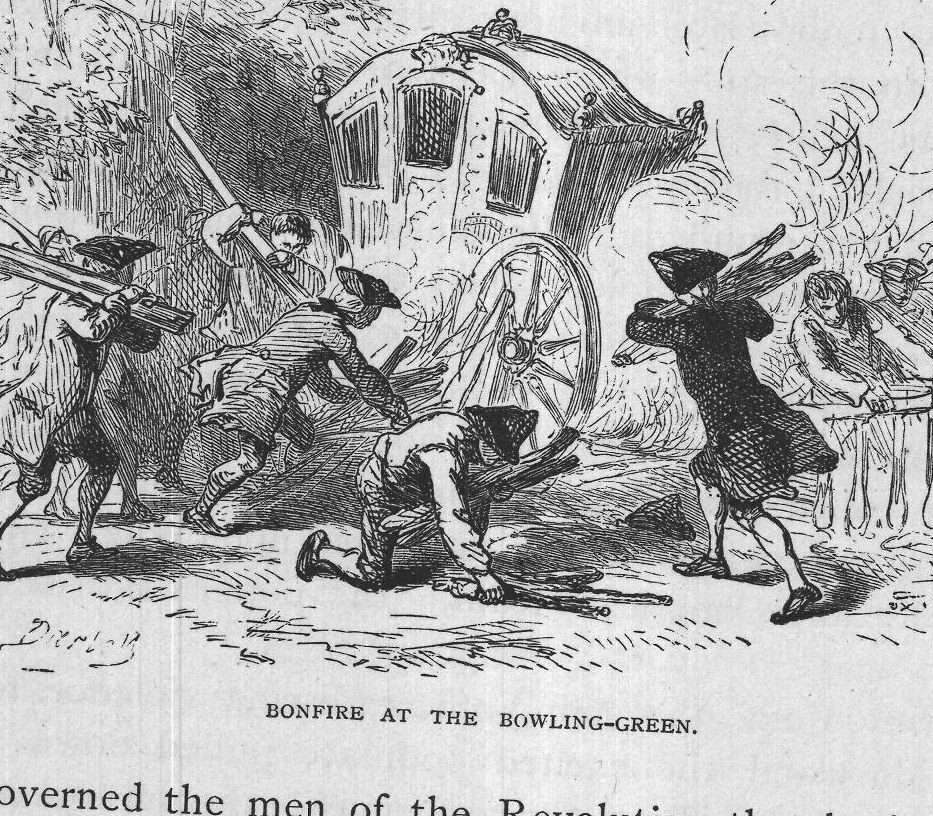
Cadwallader Colden, a venerable Scotchman, then eighty years of age, was acting-governor of New York. He was a liberal-minded man, but duty to his sovereign and his own political convictions compelled him to oppose the popular movements. James McEvers was appointed stamp-distributor for New York. The Sons of Liberty demanded his resignation. The governor protected him. When, late in October, stamps arrived, McEvers, alarmed, refused to receive them, and they were taken to the fort at the foot of Broadway for safety. The garrison was strong, and the governor had strengthened the works. This covert menace exasperated the people. Although armed British ships were riding in the harbor, and the guns of the fort were pointed toward the town, the Sons of Liberty were not afraid. They appeared in large numbers before the fort, and demanded the stamps. A refusal was answered by defiant shouts. An orderly procession soon became a roaring mob. Half an hour after the refusal, the governor was hung in effigy on the spot where Leisler, the democrat, was executed seventy-five years before. Then the mob went back to the fort, dragged Colden's fine coach to the open space in front of it, and tearing down the wooden railing that surrounded the Bowling Green, piled it upon the vehicle, and made a bonfire of the whole. Then they rushed out of town to the beautiful dwelling-place of Major James, of the artillery (at the present intersection of Worth street and West Broadway), where they destroyed his fine library, works of art and furniture, and desolated his beautiful garden, leaving his seat, called Ranelagh, a ruin. After parading the streets with the stamp act printed on large sheets and raised upon poles, with the words, "England's Folly and America's Ruin," the populace dispersed to their homes.
In New Jersey, Coxe, the stamp-officer, fearing violence, resigned. At Annapolis, in Maryland, the excited populace pulled down a house that Zachariah Hood, a stamp-officer, was repairing for the purpose, they thought, of selling stamps in it, and the governor dared not interfere. General alarm prevailed among the officers of the crown. They saw that the Americans were thoroughly aroused and very strong. In other colonies not here named, there was equal firmness, but less violence, in preventing the sale of stamps; and when the first of November arrived, the law, so far as its enforcement was concerned, was a nullity.
The invitation of Massachusetts for the colonies to meet in a representative convention in New York was promptly responded to favorably, and the famous "Stamp Act Congress," so called, assembled at New York on the 7th of October. Twenty-seven delegates were present, representing nine colonies, namely, Massachusetts, Rhode Island, Connecticut, New York, New Jersey, Pennsylvania, Delaware, Maryland, and South Carolina. Timothy Ruggles of Massachusetts, a rank tory at heart, was chosen to preside, and John Cotton was appointed secretary. Communications were received from the assemblies of New Hampshire, Virginia, North Carolina and Georgia, saying they would agree to whatever might be done by the Congress. That body continued in session fourteen days, and the whole subject of the rights and grievances of the colonies was fully discussed. John Cruger of New York, was deputed to write a Declaration of Rights; Robert R. Livingston of New York, prepared a Petition to the King; and James Otis of Massachusetts, wrote a Memorial to both Houses of Parliament. These were adopted, and have ever been regarded as able state papers. They embodied the principles that governed the men of the Revolution that broke out ten years afterward. The proceedings were signed by all but the President and Robert Ogden of New Jersey, both of whom thus early manifested their defection from a cause which they afterward openly opposed. Ruggles was censured for his conduct by a vote of the Massachusetts Assembly, and was reprimanded, in his place, by the Speaker. He afterward became a bitter Tory, and took up arms for the king. In Mrs. Mercy Warren's drama called The Group, Ruggles figures as Brigadier Hate-all. Ogden was also publicly censured for his conduct; was burned in effigy, and at the next meeting of the New Jersey Assembly was dismissed from the Speaker's chair, which honorable post he held at the time of the Congress. These men had insisted in that body that resistance to the act was treason, and they, in turn, were denounced as traitors to the rights of man.