Cornwallis Marches for the Sea-Coast
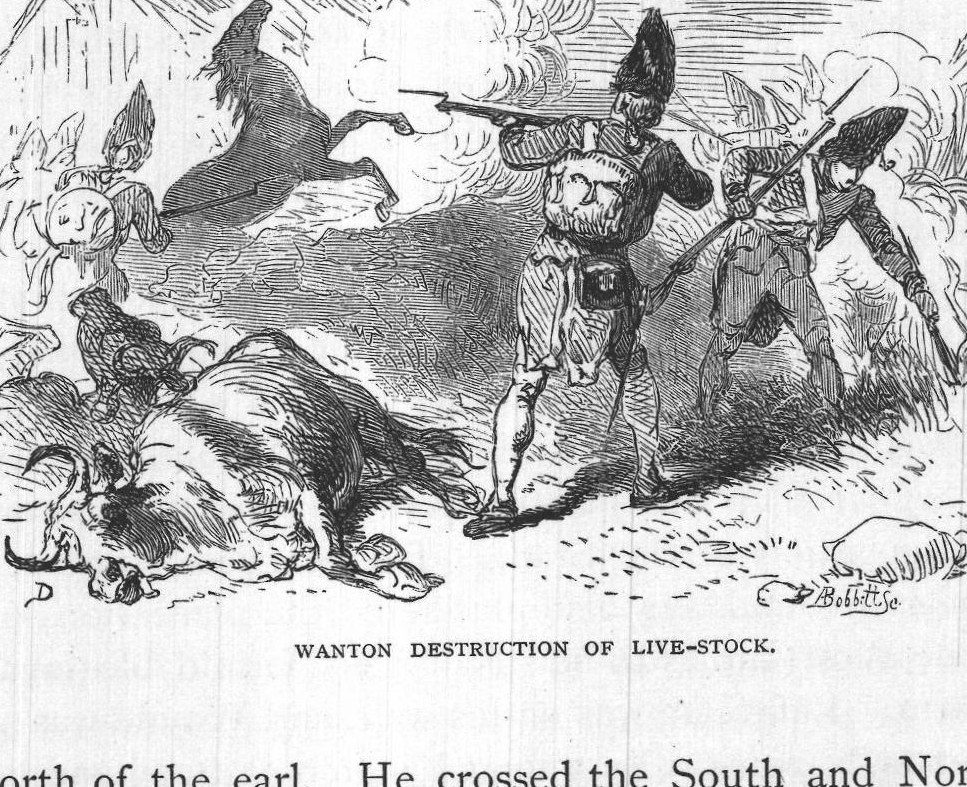
Cornwallis was now at Jefferson's Elk Hill plantation, near the Point of Forks, where he committed the most wanton destruction of property, cutting the throats of young horses not fit for service, slaughtering the cattle, burning the barns with the crops of the previous year, and destroying the growing ones, laying all the fences on the estate in ashes, and carrying away about thirty slaves. The agile Lafayette had now turned upon the earl. The latter supposing the forces of the marquis to be much greater than they really were, turned his face toward the sea-coast and retreated down the peninsula to Williamsburg, making his pathway a black line of desolation. It is estimated that during this invasion of Virginia, from the advent of Arnold in January, until Cornwallis reached, Williamsburg late in June, property to the value of fifteen million dollars was destroyed, and thirty thousand slaves were carried off. The British had been closely followed by Lafayette, Wayne and Steuben, and were allowed to rest at Williamsburg. They were there reinforced, and were protected by shipping.
A few days after reaching Williamsburg, Cornwallis received an order from Sir Henry Clinton to send three thousand of his troops to New York, then menaced by the combined American and French forces. Clinton also directed the earl to take a defensive position in Virginia at some healthy location, and fortify it. This order greatly irritated the earl, for he regarded it as an intentional frustration of his own plan for an active campaign in Virginia. He aspired to Clinton's place, and was a favorite of Germain. Clinton knew that, and for a long time the two commanders had been excessively jealous of each other.
Cornwallis, satisfied that after he should send away so large a detachment of his army he could not cope with Lafayette, determined to cross the James River and make his way to Portsmouth. This movement was accelerated by the bold attitude of the republican troops, who were pressing close upon him. On the 6th of July, a detachment sent out by Wayne to capture a British field-piece, boldly resisted a large portion of Cornwallis's army, as the former fell back to Lafayette's main force near the Green Spring plantation, the estate of Governor Berkeley, where a sharp skirmish occurred, in which the marquis had a horse shot under him, and each party lost about a hundred men. The blow was so severe that Cornwallis hastened to cross the river, which he did on the 9th of July, and marched without further molestation to Portsmouth. Disliking that situation, he went to Yorktown, on the York River, and there, upon a high and healthful plain, he established a fortified camp. he also threw up strong military work at Gloucester, on the opposite side of the river. Here we will leave the earl, while we take a brief survey of military events in the Carolinas.