Congratulatory Despatches on Lincoln's Election
I have cited these few utterances from speakers and writers who were participants or cotemporaries with the actors in the events of the late Civil War, that the reader may have a key to the real causes which brought about that war. These seem to have been chiefly a desire on the part of the slaveholders to be freed from social and political contact with the people of the free-labor States (whom they regarded as less cultivated, refined, chivalric, and civilized than themselves), with perfect freedom to extend and perpetuate the system of slave-labor, and revive, without hindrance, the African slave-trade. Notwithstanding the Charleston Mercury, at the beginning, gave greater prominence to the first-named cause, after more than three years of war (February, 1864), it was constrained to say: "South Carolina entered into this struggle for no other purpose than to maintain the institution of slavery Southern independence has no other object or meaning. Independence and slavery must stand or fall together."
When the election of Mr. Lincoln was certified, the political leaders in South Carolina were eager to begin the contemplated revolution. To be prepared for immediate action, an extraordinary session of the Legislature was assembled at Columbia on the 5th of November; and as the news of the result of the election went over the land, the governor of the State received congratulatory despatches from other commonwealths wherein the politicians were in sympathy with the Secessionists. "North Carolina will secede," a despatch from Raleigh said. "A large number of Bell men have declared for secession; the State will undoubtedly secede," said another from the capital of Alabama. Another from Milledgeville, Georgia, said: "The hour for action has come. This State is ready to assert her rights and independence. The leading men are eager for the business." "There is a great deal of excitement here," said a despatch from Washington city; "several extreme Southern men, in office, have donned the palmetto cockades and declared themselves ready to march South." A despatch from Richmond said: "If your State secedes, we will send you troops and volunteers to aid you." "Placards are posted about the city," said a message from New Orleans, "calling a convention of those favorable to the organization of a corps of minute-men." A second message from Washington said: "Be firm; a large quantity of arms will be shipped South from the Arsenal here to-morrow. The President is perplexed. His feelings are with the South, but he is afraid to assist them openly."
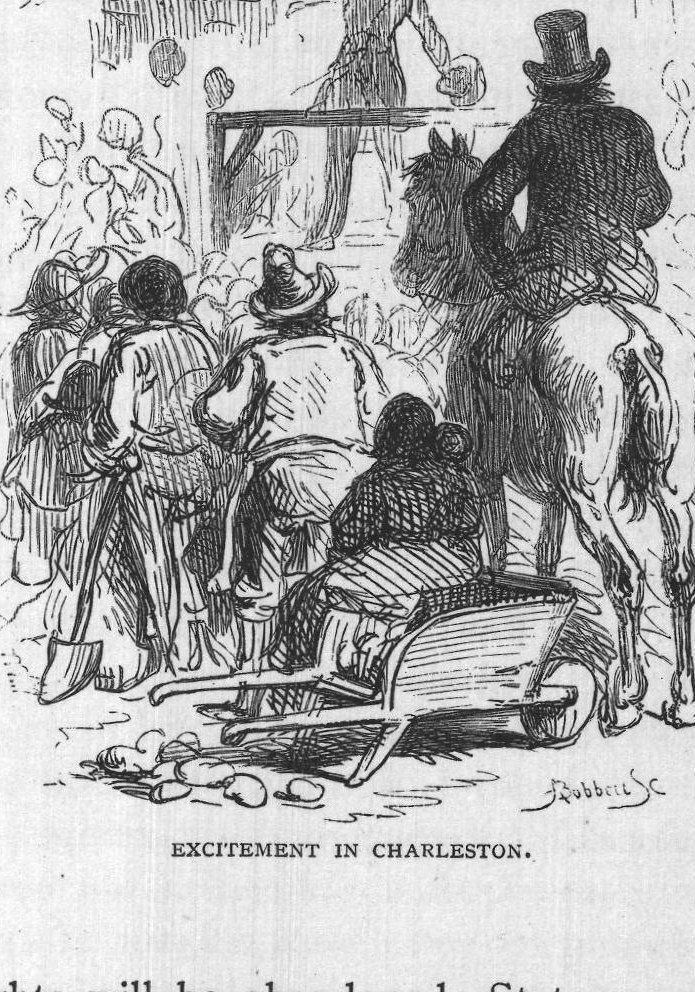
So was revealed the fact that simultaneous action in favor of disunion had been preconcerted. As these despatches came, one after the other, to Columbia, and were immediately forwarded to Charleston, a blaze of pleasurable excitement was kindled among the citizens of the latter place. The palmetto flag, the emblem of the sovereighty of the State, was everywhere displayed. From the thronged streets went up cheer after cheer for a Southern Confederacy. All day long on the 7th of November, when it was known that Mr. Lincoln was elected, the citizens were harangued in the open air and in public halls, the speakers portraying the glories of State independence. Flags and banners, martial music, and the roar of cannon attested the general joy; and that night blazing bonfires and illuminations lighted up the city. Multitudes of palmetto cockades (made of blue silk ribbon, with a button in the centre bearing the figure of a palmetto tree) were worn in the streets of Charleston. Public offices under the Government of the United States were closed, or transferred to the "sovereign State" of South Carolina, in the most formal manner. On the 7th of November, Judge McGrath, of the United States District Court, solemnly resigned his office, saying to the jurors: "For the last time I have, as judge of the United States, administered the laws of the United States within the limits of South Carolina. So far as I am concerned, the temple of justice raised under the Constitution of the United States is now closed." He then laid aside his judicial gown and retired. The collector of customs at Charleston resigned at the same time; so also did the attorney-general. So it was that before a convention to consider the secession of the State from the Union had been authorized, the Secessionists, with plans matured, acted as if disunion had been already accomplished.