Confederate Commissioners at the Capital
The little National navy, like the army, had been placed far beyond the reach of the Government, for immediate use. It consisted of ninety vessels of all classes, but only forty-two were in commission. Twenty-eight, carrying an aggregate of nearly nine hundred guns, were lying in ports, dismantled, and could not be made ready for sea, some of them, in several months. Most of those in commission had been sent to distant seas; and the entire available force for the defence of the whole Atlantic coast of the Republic was the Brooklyn, 25, and the store-ship Relief, of two guns. The Brooklyn drew too much water to enter Charleston harbor, where war had begun, with safety; and the Relief had been ordered to the coast of Africa with stores for the squadron there. Many of the naval officers were born in slave-labor States; so also were those of the army; and many of both arms of the service deserted their flag at the critical moment, and joined the enemies of their Government. The amazing fact was presented that Mr. Buchanan's Secretaries of War and Navy had so disposed the available military forces of the Republic that it could not command their services at the critical moment when the hand of its enemy was raised to destroy its life. The public offices were swarming with disloyal men, and for a full month the President, knowing the importance of having faithful instruments to work with, was engaged in relieving the Government of these unfaithful servants. He wisely strengthened his arm by calling to his aid loyal men, before he ventured to strike a blow in defence of the threatened National authority.
We have observed that the Convention at Montgomery appointed commissioners to treat with the National Government upon matters of mutual interest. Two of these (John Forsyth and Martin J. Crawford) arrived in Washington city on the 5th of March (1861), and asked for an "unofficial interview" with the Secretary of State. It was declined, when they sent him a sealed communication setting forth the object of their mission as representatives of "a government perfect in all its parts, and endowed with all the means of self-support," and asking for an opportunity to "present their credentials" at an early day. This communication-this adroit attempt to obtain a recognition of the sovereignty of the Confederate States from the National Government, failed. In a "memorandum" which he sent to them, the Secretary referred to the principles laid down in the inaugural address, and, like Mr. Lincoln, he declared the doctrine that no State as a State had seceded or could secede, and that, consequently, the "Confederate States government" had no legal existence. The commissioners remained more than a month in Washington, and then, after giving the Secretary (Mr. Seward) a lecture on the theory of government, they left for home on the day when the South Carolinians proceeded to attack Fort Sumter.
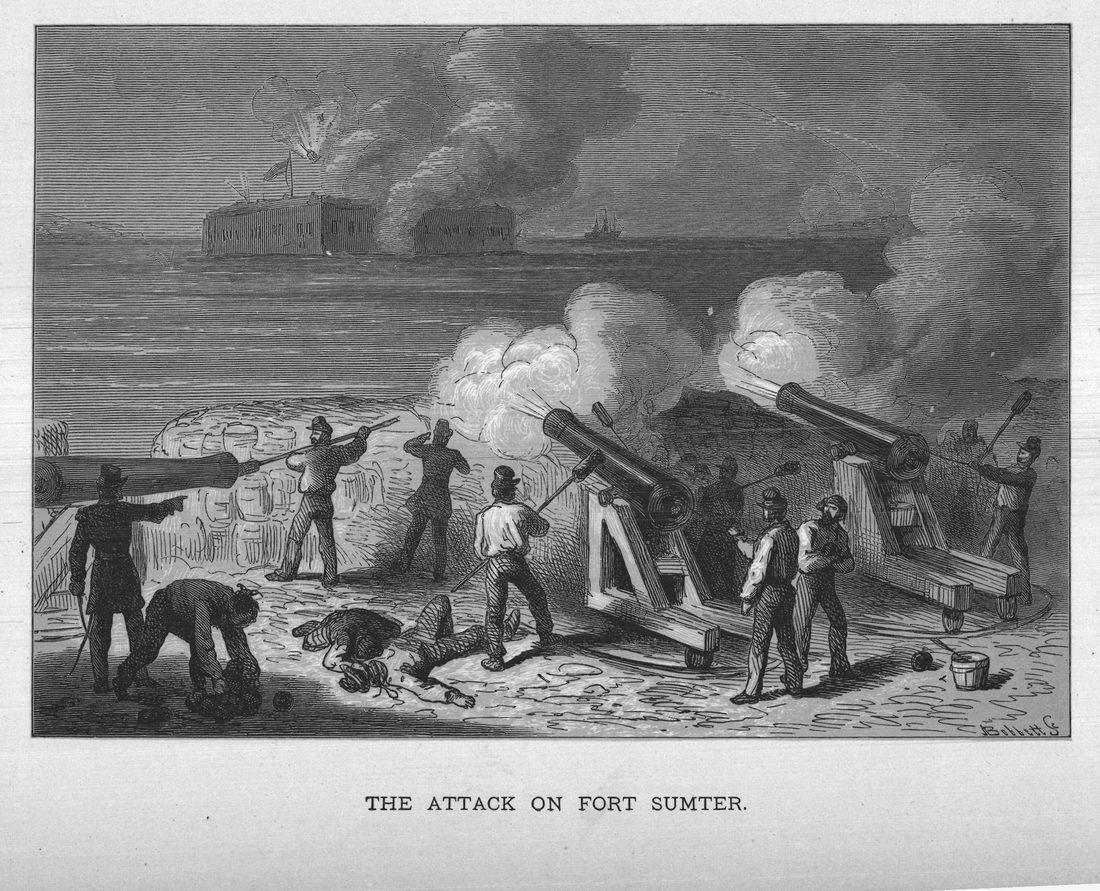
Among the first questions that demanded the attention of the new Administration was, "Shall Fort Sumter be reinforced and supplied?" They were anxious for peace, and the question was kept in abeyance until late in March, when Gustavus V. Fox (afterward the efficient Assistant Secretary of the Navy) was sent to Charleston harbor to ascertain the exact condition of things there. He found that Major Anderson had sufficient supplies to last him until the 12th of April, and it was understood between them that if not supplied, he must surrender or evacuate the fort at noon on that day. On his return to Washington Mr. Fox reported to the President that if succor was to be afforded to Anderson, it must be before the middle of April. The President, anxious for peace, and not to bring on a collision with the South Carolina insurgents, had listened favorably to urgent advice to abandon Sumter and not precipitate hostilities. The Virginia State Convention was then in session considering the propriety of leaving the Union. Mr. Lincoln sent for a professed Union man in that body, and said to him, "If your Convention shall adjourn, instead of staying in session menancing the Government, I will immediately direct Major Anderson to evacuate Fort Sumter." Had the Virginia politicians wanted peace, this request would have been complied with. On the contrary, this professed Virginia Unionist replied, "Sir, the United States must instantly evacuate Fort Sumter and Fort Pickens, and give assurances that no attempt will be made to collect revenue in the Southern ports."