"Citizen Genet" and the Republicans
Jefferson soon rallied under his standard a large party of sympathizers with the French revolutionists. Regarding Hamilton as the head and front of the monarchical party, he professed to believe that the financial plans of that statesman were designed to enslave the people, and that the rights and liberties of the States and of individuals were in danger. Hamilton, on the other hand, regarded the national Constitution as inadequate in strength to perform its required functions, and believed weakness to be its greatest defect. With this idea Jefferson took issue. He charged his political opponents, and especially Hamilton, with corrupt and anti-republican designs, selfish motives, and treacherous intentions; and so was inaugurated that system of personal abuse and vituperation which has ever been a disgrace to the press and political leaders of this country. Bitter partisan quarrels now prevailed, in which Jefferson and Hamilton were the chief actors. The people were greatly excited. The Republicans, who hated the British intensely, called the Federalists the "British party," and the Federalists called their opponents the "French party." The latter hailed with joy the news of the death of the French king, and applauded the declaration of war against England and Holland, forgetting the substantial sympathy which the latter had shown for the Americans during their struggle for independence. Only Washington appeared calm in the midst of the uproar that proceeded from antagonists in his cabinet.
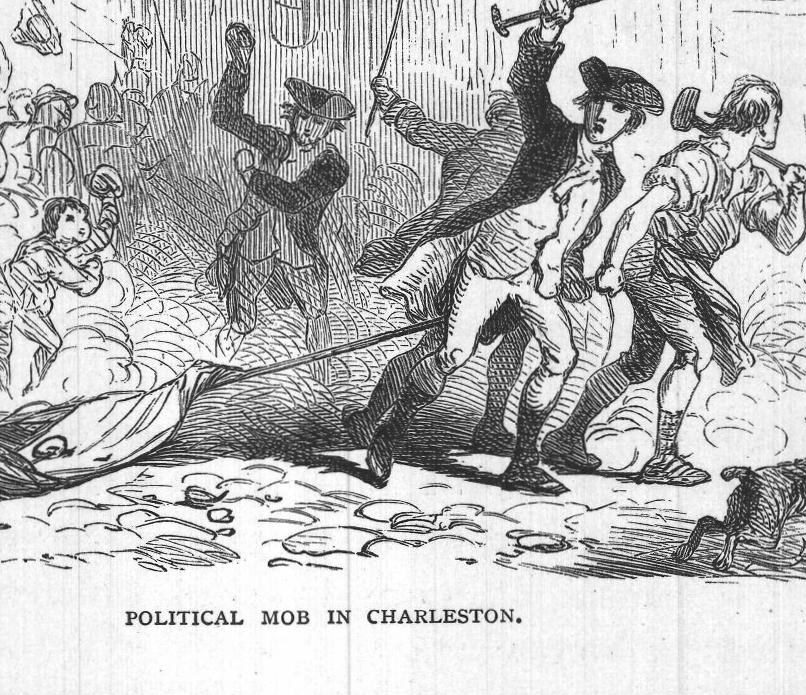
In the midst of this excitement "Citizen Genet," as he was called, an ambassador sent to our government by the French Republic, arrived at Charleston, South Carolina, where he was cordially received, in April, 1793. Washington had anxiously watched the rising tide of popular sentiment in favor of giving material aid to the French in their warfare on monarchies, and on the 22d of April he issued a proclamation of neutrality, in which he warned all citizens of the United States not to engage in the kindling war in Europe. This gave great offence to the Republicans, or Democrats, and Washington was abused without stint.
Genet's zeal outran his prudence. Without waiting to present his credentials, or even to visit the seat of our national government, he proceeded to act upon instructions of his own so-called government. He had been furnished with blank naval and military commissions, and was empowered to constitute every French consul in the United States a court of admiralty, authorized to sell prizes. Then he proceeded to fit out privateers to depredate upon the commerce of England, Holland, and Spain. One of them went prowling up our coast, and reached Philadelphia (to which city the national government had been removed) with a prize before Genet arrived there. He was received with enthusiasm on his arrival; and so anxious were his admirers to do homage to their idol, that they invited him to a public dinner before he had presented his credentials.
Genet was deeply impressed with Washington's dignity, but felt uneasy in his calm presence; so, after the ceremony of his first presentation was over, he hastened to the dinner to which he was invited, where he might easily have imagined himself to be in a Jacobin Church in Paris--songs, toasts, decorations, were all to his taste. On the table was a roasted pig, to which they gave the name of the lately murdered king. Its head, severed from its body, was carried around the table to each guest, who, after putting the bonnet rouge on his own head, pronounced the word "tyrant" and proceeded with a knife to mangle that of the animal to be served to so unworthy a company. Strange as it may seem to us, it is nevertheless true, that so infatuated were the partisans of the French, that leading citizens of Philadelphia, with General Mifflin, then governor of Pennsylvania, at their head, participated in the disgraceful orgies at that dinner. A Democratic tavern in Philadelphia had a revolting sign, on which was painted the headless corpse of the murdered queen. "Democratic clubs" were formed in imitation of the Jacobin clubs of Paris; and, encouraged by these and newspapers in their interest, Genet persisted in his defiant course, and tried to excite hostility between our people and their government. His acts finally disgusted Jefferson and all patriotic men. The atrocities of the French revolutionists, when known, produced a revulsion of feeling in the United States, and Washington finally requested and obtained Genet's recall. Fouchet, who succeeded him, was instructed to assure the President that Genet's course was not approved. The latter dared not return to France at that time, for he feared the sanguinary men whom he had represented. He married a daughter of Governor Clinton, settled in this country, and became a useful citizen. Our government had passed through great peril, but the helm of the ship of state was in the hand of a wise and expert pilot. No doubt the firmness and prudence of Washington, at that time, saved the republic from utter ruin.