Capture of York and Fort George
A second invasion of Canada was a capital feature in the general plan of the campaign of 1814. General Dearborn, who was in immediate command of the northern army, had about six thousand troops under his control. These were to defend the frontier from Buffalo to St. Regis, and to them was also given the task of capturing Montreal and the province of Upper Canada. Chauncey had gained such a mastery on Lake Ontario, that it was believed he might easily confine the British squadron to Kingston Harbor, where it was ice-bound during the winter. The plan of the campaign sent from the War Department reached General Dearborn at Plattsburg at near the middle of February, and he immediately made preparations for the invasion by concentrating troops at Sackett's Harbor and Buffalo. When Dearborn arrived at the former post, at about the first of March, rumors were current there that Sir George Prevost was in command of six or eight thousand men, and was actively engaged in preparations for offensive operations. Dearborn found only about three thousand troops at the Harbor. General Brown was ordered to summon several hundred of the militia to the field; and Colonel Pike was directed to hasten to the Harbor from Plattsburg with four hundred of his best men. Henry Eckford arrived soon after Dearborn, with instructions to build six war-schooners at Sackett's Harbor; and orders were given to Chauncey for the purchase of as many more as the exigencies of the service might require.
At the middle of April, Dearborn and Chauncey matured a plan of invasion with a combined land and naval force. It was to cross over the lake and capture York (now Toronto), and then to assail Fort George, near the mouth of the Niagara River. At the same time troops were to cross in the vicinity of Buffalo and capture Forts Erie and Chippewa, join the victors at Fort George, and all proceed to capture Kingston. With seventeen hundred troops under the immediate command of Pike, who had lately been commissioned a brigadier-general, Dearborn sailed in Chauncey's fleet from Sackett's Harbor on the 25th of April, and on the morning of the 27th, the armament appeared before York. The land forces disembarked about two miles westward of the British fortifications there, in the face of a galling fire from regulars and Indians under General Sheaffe. These were soon driven back to their works, and the Americans, led by the brave Pike, pressed forward and captured two redoubts. At the same time Chauncey was hurling upon the foe deadly volleys of grape-shot from his naval cannon.
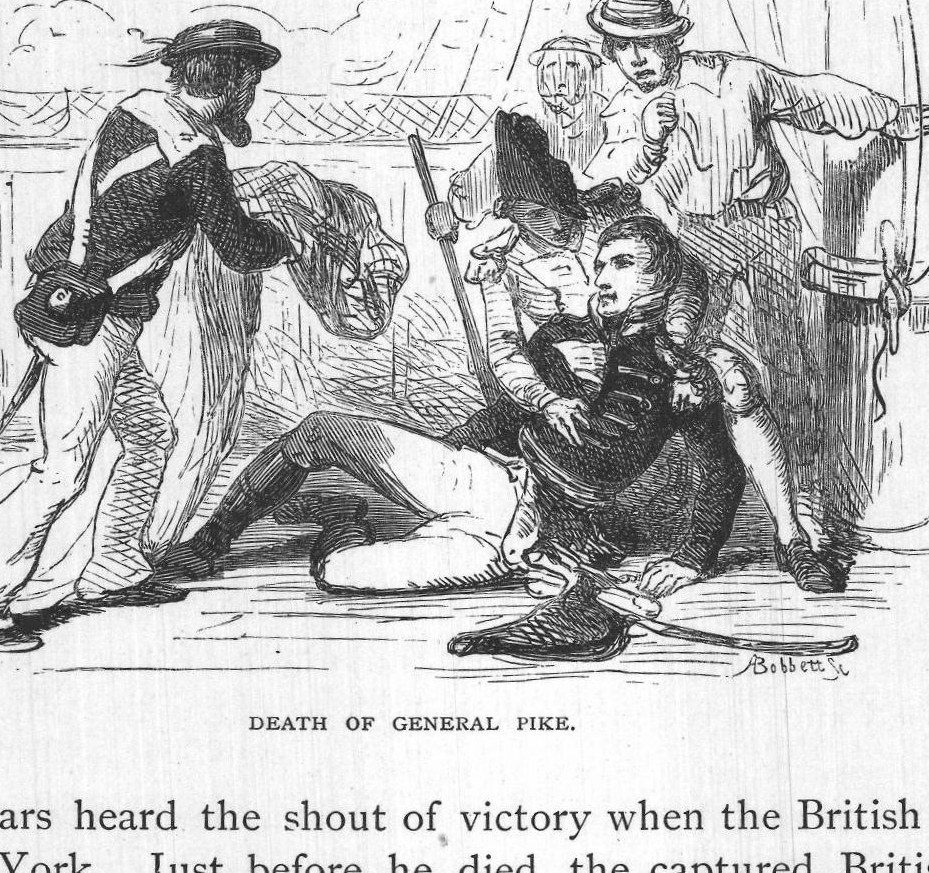
Sheaffe and his little army, deserted by the Indians who had fled before the roar of artillery, now took post with the garrison near the governor's house and opened a heavy fire of round and grape-shot upon the invaders. This battery was soon silenced by Pike's heavy guns, and it was expected that a white flag, in token of surrender, would soon appear, when a sudden and awful catastrophe occurred. General Pike was sitting on the stump of a tree talking with a captive British officer, when a tremor of the earth was felt and was immediately followed by a tremendous explosion near by. The British, unable to hold the fort, had fired a magazine of gunpowder on the edge of the lake. The effect was terrible. Fragments of the timber and huge stones, of which the magazine walls were built, were scattered in every direction over a space of several hundred feet and more. When the smoke floated away, the scene was appalling. Fifty-two Americans lay dead, and one hundred and eighty others were wounded. Forty of the British were also slain. General Pike, two of his aides, and the captive officer, were mortally hurt. The dying general was taken to one of Chauncey's vessels. His benumbed ears heard the shout of victory when the British ensign was pulled down at York. Just before he died, the captured British flag was brought to him. He smiled, and made a sign for it to be placed under his head. It was done, and he expired. The civil authorities of York and the militia officers formally surrendered the place, while Sheaffe and a larger part of his force, after destroying some vessels and store-houses, escaped to Kingston. The Americans lost in killed and wounded two hundred and eighty-six men; the loss of the British (besides prisoners), in killed and wounded, was one hundred and forty men.