Capture of Hatteras Forts
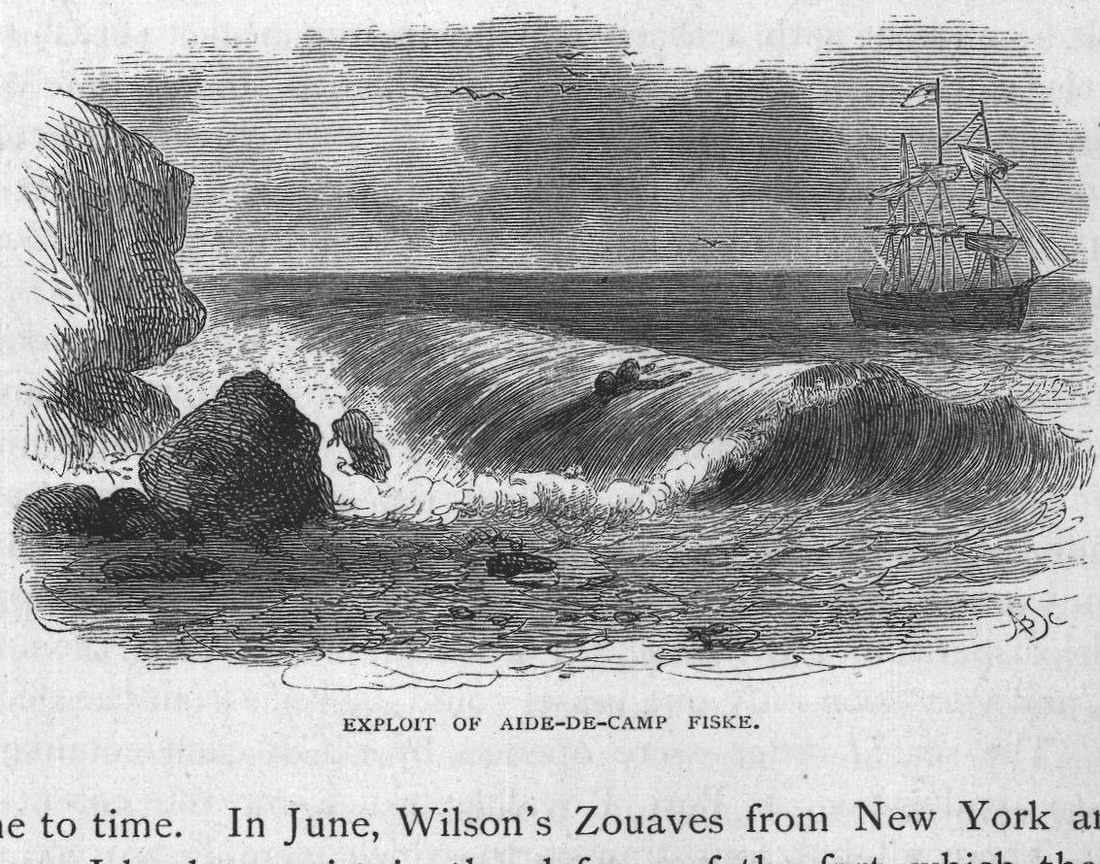
In the summer of 1861, the Confederates built two forts on Hatteras Island, off the coast of North Carolina, which guarded the entrance to Hatteras Inlet, through which the British blockade-runners had begun to carry in supplies to the insurgents. General B. F. Butler, then in command at Fortress Monroe, proposed the sending of a land and naval force against these forts. It was undertaken late in August; and when, toward the close of summer (just after the village of Hampton had been laid in ashes by Virginia troops under Magruder), Butler was succeeded in command at Fortress Monroe by the veteran General John E. Wool, the former volunteered to command the land forces for the purpose. An expedition, composed of eight transports and war-ships under Commodore Stringham, bearing almost nine hundred land troops commanded by Butler, left Hampton Roads for Hatteras Inlet on the 26th of August, and on the morning of the 28th the vessels of war opened fire upon the forts (Hatteras and Clarke) and some of the troops were landed. An assault by both arms of the service was kept up until the 29th, when the forts were surrendered, and the expedition returned to Hampton Roads, leaving a portion of Colonel Hawkins's New York Zouaves, with their commander, to garrison the captured post. During the siege, Mr. Fiske, acting aide-de-camp to General Butler, performed a gallant deed. When one of the forts (Clarke) was abandoned, he swam ashore, through heavy breakers, with orders for Colonel Weber, who was on the island. Fiske entered the evacuated fort, and found books and papers containing valuable information. These he formed into a package, strapped it high upon his shoulders, and swam back with them to the ship. The information they contained gave the assailants great advantages.
The victory at Hatteras finally led to important results, as we shall perceive hereafter. The politicians of North Carolina had annexed that State to the Confederacy. A conciliatory address to the inhabitants, issued by Colonel Hawkins, led to a Convention on the Eastern Shore, which, on the 16th of November, 1861, adopted a declaration of independence of the Confederacy. It promised so much good that President Lincoln authorized the election of a Congressman from that district. But the heel of despotic power soon crushed this germ of active loyalty among four thousand inhabitants, and it almost disappeared for a time.
We have observed that Fort Pickens, on Santa Rosa Island off the harbor of Pensacola, was saved from the insurgents early in 1861, by the vigilance and bravery of Lieutenant Slemmer. He was furloughed for rest, and Colonel Harvey Brown took his place. The garrison was reinforced from time to time. In June, Wilson's Zouaves from New York arrived on Santa Rosa Island to assist in the defence of the fort, which the Confederates ardently coveted. The latter had gathered in large numbers on the main; and in October they attempted to surprise and capture Wilson's troops, on a dark night, landing and rushing upon their camp with the cry of "Death to Wilson! No quarter!" The Zouaves fought desperately in the gloom, and, with the aid of men from the fort, drove the assailants to their boats. The Confederates lost one hundred and fifty men; the Nationals, sixty-four. Wilson's camp was burned by the enemy, and that was the most that the assailants achieved.
These events were followed, late in November, by a severe cannonade and bombardment of the Confederate works on the main, by Fort Pickens and war-vessels. There were seven thousand men under General Braxton Bragg, encamped behind these works and in a curved line from the Navy-yard to Fort McRee, a distance of about four miles. The works consisted of forts and batteries. In the course of forty-eight hours after the bombardment was begun, most of the heavy guns of the Confederates were silenced, and a greater portion of the Navy-yard and the villages of Wolcott and Warrington adjoining, were laid in ashes by shells from Fort Pickens. After that, for a few weeks, quiet prevailed in Pensacola Bay, when it was broken by another artillery duel on the 1st of January, 1862. It lasted about twelve hours, but with very little damage to either party.
Meanwhile a speck of war had appeared at the Southwest Pass at the mouth of the Mississippi River. Captain J. S. Hollins of the National navy, who had deserted his flag, was in command there of a Confederate "ram"--an iron-clad gun-boat with a sharp and heavy iron beak to crush or punch holes in the sides of wooden vessels. It was called Manassas. With this formidable monster, which might have been very mischievous in competent hands, Hollins attacked the National blockading squadron under Captain Pope; but he was soon driven up the river to Fort Jackson, after doing slight damage to one or two of the vessels.