Bravery of the Latter
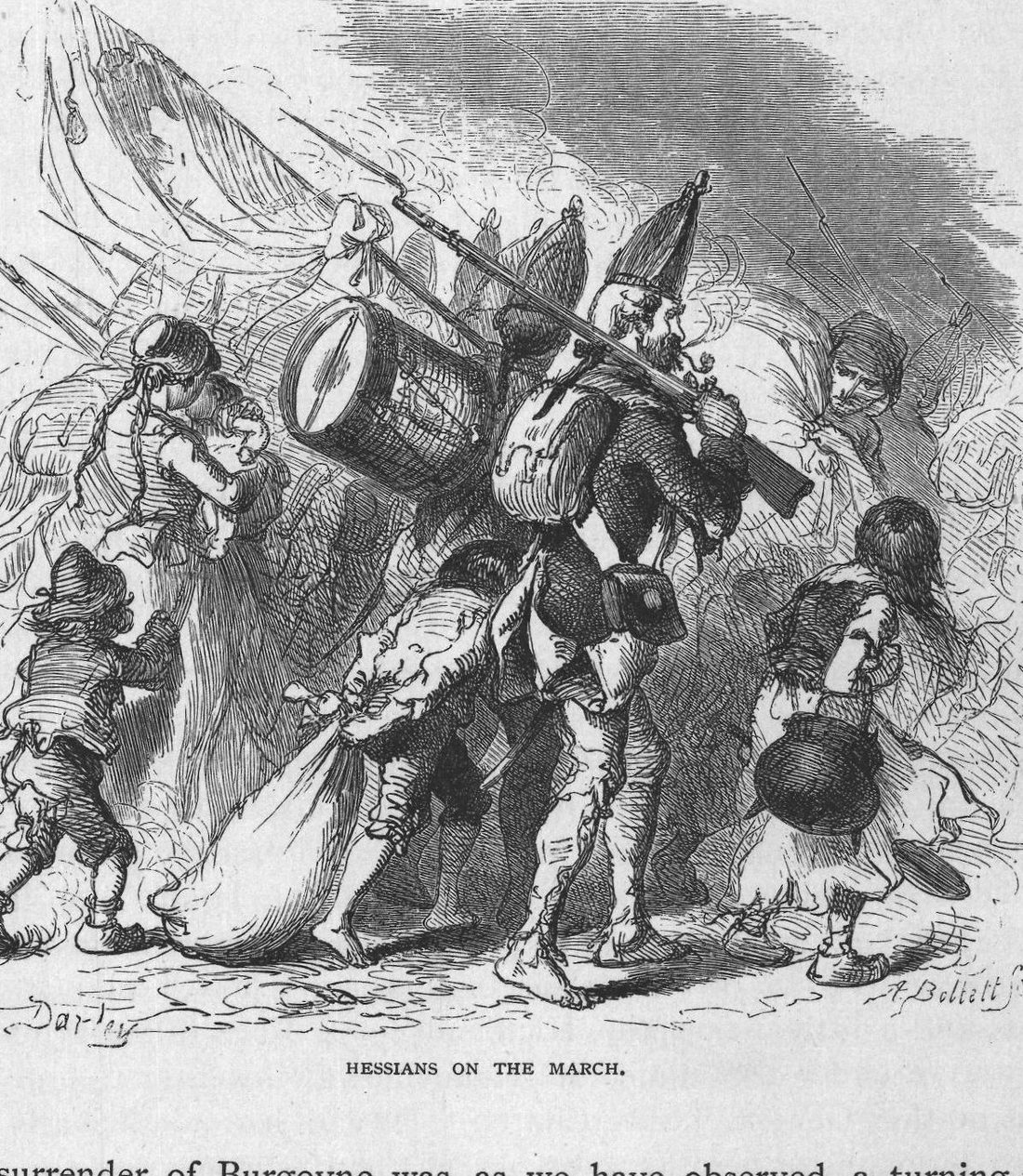
Arnold now ordered up from the left the New York regiments of Wesson and Livingston, and Morgan's riflemen, to make a general assault, while Colonel Brooks, with his Massachusetts regiment, accompanied by Arnold, attacked the German troops commanded by Breyman. Arnold rushed into the sally-port on his powerful horse, and spread terror among the Hessians there. They had seen him in the thickest of the fight, for two hours, unhurt, and regarding him with superstitious awe, as one possessed of a charmed life, they fled. They gave a parting volley in their retreat, which killed Arnold's horse and severely wounded the same leg that was badly hurt at Quebec. Then, at the moment of victory, and at the head of his troops, wounded and disabled, he was overtaken by Major Armstrong, who had resumed the chase, and received from him the order from Gates to return to camp, for the commander-in-chief feared Arnold might "do some rash thing." He had done a "rash thing" in achieving a decisive victory--a triumph which proved to be a turning-point in the war in favor of the Americans--without the orders or even the permission of his commander.
The glamour of false light which often surrounds the commander of a victorious army frequently conceals the truth, and deprives the most meritorious of the actors of their just reward. The dazzled public lauded Gates as a great general, because he was the commander of the victorious army on this occasion, when the truth assures us that he was a hindrance instead of an aid, in the achievement of the triumph. While Arnold was reaping golden sheaves of glory for Gates's garner, by wielding the fierce sickle of war, the latter and General Lincoln, his second in command, did not appear upon the field of battle. Gates, it is said, did not leave his tent at all that day, for he had not recovered from a debauch in which he had indulged the night before. His favorite aide (Wilkinson) said afterward, that when he went to headquarters for orders in the afternoon, he found Gates more intent upon discussing the merits of the Revolution with Burgoyne's dying aide than upon winning the battle then raging. He followed Wilkinson as he went out, and asked him-- "Did you ever hear so impudent a son of a --," referring to the wounded officer, who had ventured to differ with him. Poor Sir Francis Clarke died that night upon the bed of his coarse and vulgar antagonist.
It was twilight when the wounded Arnold was carried from the field. The rout of the Germans was complete. They threw down their arms and ran, and could not be rallied. Colonel Breyman was mortally wounded. The conflict ceased when the curtain of night fell upon the scene. At about midnight, the division of Lincoln marched out to the relief of those upon the field; and before the dawn, Burgoyne, who had resolved to retreat, removed his whole force a mile or two north of his intrenchments, which the Americans immediately took possession of.
General Fraser died on the morning after the battle, and his body was buried, at the evening twilight of the same day, within a redoubt upon a gentle eminence, which the hero had chosen for his place of sepulture. A very touching account of his death and his funeral is given in the published letters and memoirs of the Baroness de Riedesel, wife of the Brunswick general, who, with her children, accompanied her husband while he was in America. The body of Fraser was followed to the grave by Burgoyne and a large number of officers led by Mr. Brudenell, the faithful chaplain of the artillerists. As the funeral procession moved up the slope in the dim light, it appeared to Americans like a hostile movement, and they opened a cannonade upon it from the eastern side of the Hudson; but as soon as its solemn character was made known, the cannonade for destruction was changed to the firing of minute-guns in honor of the memory of the brave soldier.
The wife of Major Ackland (a daughter of the Earl of Ilchester), who accompanied her husband, and was with Madame Riedesel during the battle of the 7th of October, when she heard that her husband was wounded and a prisoner, resolved to go to the American camp in search of him. On a dark and stormy night she descended the Hudson in an open boat, accompanied by Chaplain Brudenell, and bearing a letter of introduction from Burgoyne to Gates. She found her husband at the headquarters of Arnold, now (1876) the residence of Mr. Neilson, on Bemis's Heights, where she was permitted to nurse him until he was able to travel to New York and sail for England.