Battle on the Brandywine
Washington advanced his forces beyond Wilmington, and early in September took post behind Red Clay Creek. He sent General Maxwell, with light troops, to form an ambuscade in the direction of the enemy, while with the main army he waited the approach of the foe, who moved in two clumns on the 3d of September, one division commanded by Cornwallis, and the other by Knyphausen. The advanced guard soon encountered Maxwell, when a sharp skirmish ensued and a temporary check was given to the march of the foe. On the 8th they again moved forward by way of Newark, and feigned an attack on Washington's right, while the main army halted with the expectation of turning that flank of the republican army the next morning with ease. But Washington outgeneraled Howe as he did Cornwallis at Trenton. By a swift and secret movement that night, he fell back to the Brandywine Creek, which he crossed at Chad's Ford, and took post in a strong position on the hills that skirt the eastern borders of that stream. The British were astonished at dawn on the morning of the 9th by the absence of Washington, and gave chase the same evening. The Americans stood directly in the path of the British in the proposed march upon Philadelphia.
On the 10th, the two divisions of Howe's army met at Kennet Square, and at five o'clock on the morning of the 11th a large portion of them, led by Cornwallis, marched up the Lancaster road toward the forks of the Brandywine. They left all their baggage, even to their knapsacks, with the other division, which, led by Knyphausen, marched a few hours later in a dense fog for Chad's Ford. Washington's left wing, composed of the brigades of Muhlenberg and Weedon of Greene's division, and Wayne's division with Proctor's artillery, were on the hills east of Chad's Ford. The brigades of Sullivan, Stirling and Stephen, composing the right wing, extended along the Brandywine to a point above the forks; and a thousand Pennsylvania militia, under General Armstrong, were at Pyle's Ford, two miles below Chad's Ford. General Maxwell, with a thousand light troops, was posted on the west side of the stream, to dispute the passage of Knyphausen. The latter pushed forward, and sent a strong party to dislodge Maxwell, who, after a severe fight, was driven to the edge of the Brandy-wine, where he was reinforced, and turning upon his pursuers, smote their ranks into confusion and pressed them back to their main line. Seeing a movement in force to gain his rear, Maxwell fled across the stream, leaving the western side in full possession of the enemy.
Knyphausen now brought his great guns to the high bank west of Chad's Ford, and opened them upon the Americans. He did not attempt to cross, for he was instructed to amuse the patriots with a feigned attempt to pass over, while Cornwallis should cross at the forks and gain the flank and rear of Washington's army. This accomplished, Knyphausen was to push over the stream, and both parties make a simultaneous attack.
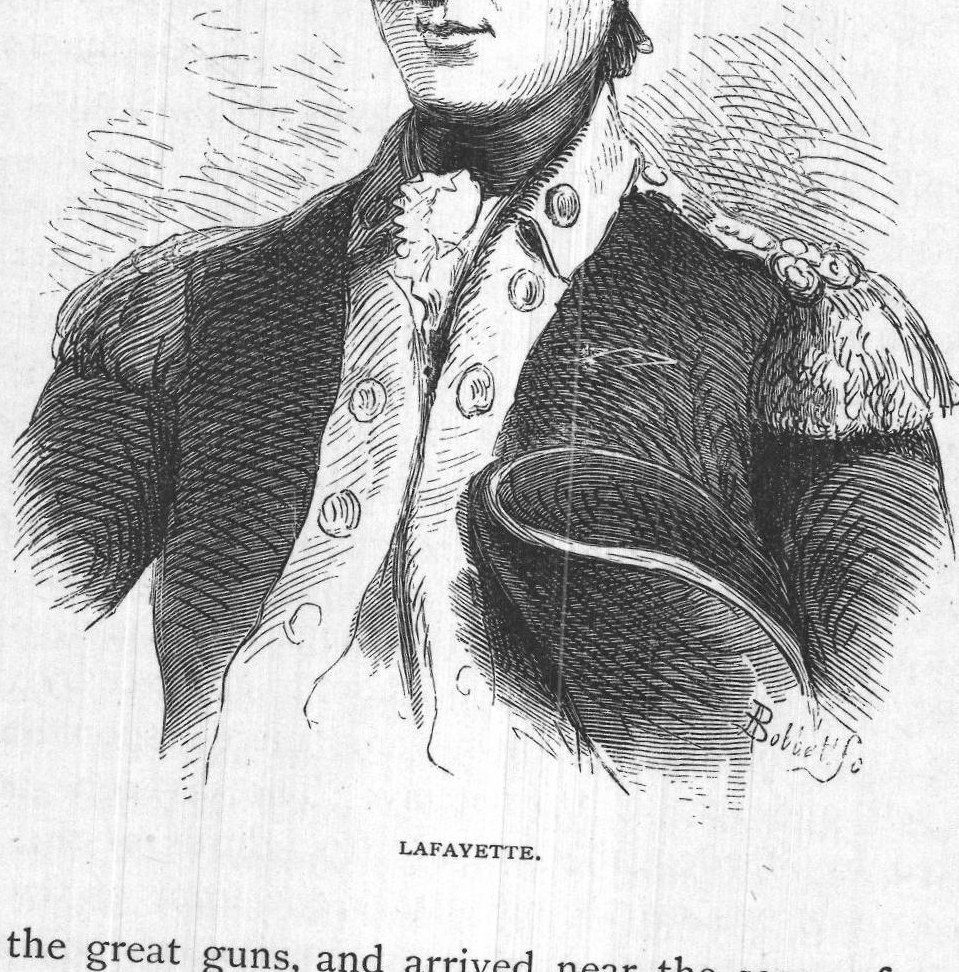
Washington resolved to strike a blow at once. He sent word to Sullivan to cross at a ford above, and attack Cornwallis, while he should pass over and assail Knyphausen. Through misinformation, Sullivan did not perform his part of the work. He sent a message to Washington, which kept him in suspense a long time. Greene, who had crossed at Chad's Ford with his advance-guard, was recalled, and Cornwallis, in the meantime, had made a wide circuit, crossed the Brandywine far up that stream, and was upon a hill near the Birmingham meeting-house, not far from Sullivan's right, before that officer was aware of his approach. The surprised general sent word to Washington of his perils, and immediately moved against the enemy. Before he could form his troops in battle order, the rested Britons attacked him. A severe battle ensued. For awhile the result was doubtful. Finally the right wing of the republicans under General De Borre gave way; then the left under Sullivan. The centre, commanded by Stirling, remained firm for awhile, when it, too, gave way, and fled in confusion. Lafayette, who was with this corps, fighting on foot as a volunteer, was badly wounded in his leg. All efforts to rally the troops were vain, excepting a few who made a momentary stand near Dilworth, when they, too, fled, and with the other regiments ran over the hills in fragments toward the main army at Chad's Ford, closely pursued by the victors. Cornwallis's cannon had made dreadful havoc in the American ranks.