Battle of Chippewa
Prompt measures were taken to secure the advantages gained by this victory; for it was known that General Riall, who was then the chief commander on that frontier and an able officer, was moving toward Fort Erie. Early that morning, on hearing of the peril that impended over the fort, he had sent forward some of the Royal Scots to reinforce the garrison. At Chippewa they heard of the capture of the fort, when Riall determined to make an immediate attack on the Americans; but hearing that reinforcements from York were near, he postponed the attack until next morning. To meet this force, General Brown sent forward General Scott, with his brigade, accompanied by Towsen's artillery, on the morning of the 4th of July. Ripley was ordered in the same direction with his brigade, but it was late in the afternoon before he was prepared to move. Scott went down the Canada side of the Niagara to a place a little more than a mile from Chippewa, driving back a British advanced detachment. The main portion of Brown's army reached Scott's encampment that night, and on the morning of the 5th the two belligerent armies were not more than two miles apart.
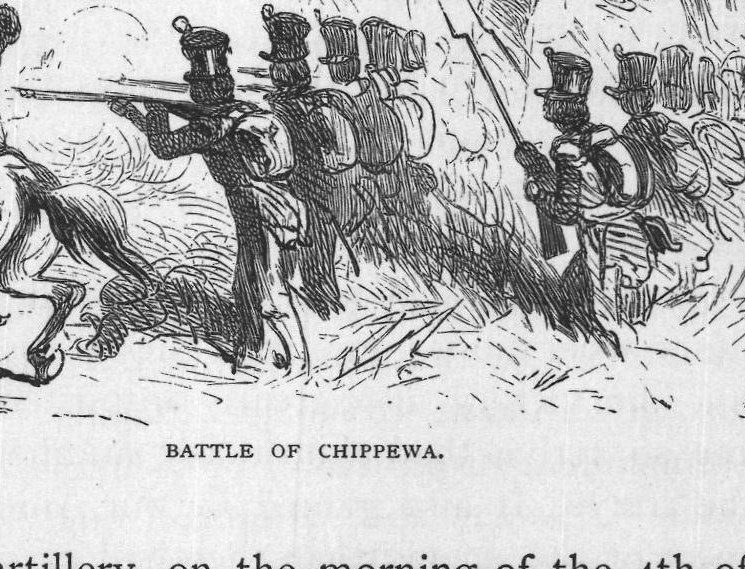
At noon on the 5th, Scott was joined by General Porter with his volunteers and Indians, and the British had also been reinforced. For some time the two armies felt of each other, when preliminary skirmishing was begun by General Porter with marked success. The Indians behaved gallantly on that occasion. Toward evening, Riall advanced with his whole force, and a desperate battle ensued between Street's Creek and Chippewa, in full view of the Niagara River. Finally a flank movement was made by Major McNeil with Campbell's regiment, and a terrific fire from a corps under Major Jesup, in the centre, made the British line give way. It broke and fled in haste toward the intrenchments below Chippewa Creek. The fugitives tore up the bridge over the creek that was behind them, leaving an impassable chasm between themselves and the Americans. The battle-field (opposite the foot of Navy Island) was strewn with the dead and the dying. The Americans lost, in killed, wounded and missing, three hundred and fifty-five men. The British had lost by the same casualties, six hundred and four men, of whom two hundred and thirty-six were killed.
The horrors of that battle-field, on that hot July evening, were mitigated by a gentle shower of rain that came like a descending angel of mercy at the close of the conflict. Many a feverish lip was moistened by it, and many a throbbing temple was cooled. All night long the wounded of both armies were tenderly cared for, and the dead were speedily buried in shallow graves. Scott was eager to pursue, but was compelled to await the tardy movements of Ripley, who did not arrive in time to participate in the action and to join in a pursuit.
There was joy in the camp of the Americans that night, for they had gained a decisive and important victory--more important in its immediate results, perhaps, than any which had preceded it. The Indian allies of the British were disheartened. Their disaffection, begun at the Thames, was now complete. Nearly all the savages who had terrified the frontiers wherever there were military operations, now left the British army and returned to their homes. The victory also greatly inspirited the Americans, and recruiting became so active that almost any number of men might have been added to the army. It also gained for our American soldiers more of the genuine respect of the enemy than they had ever received; and it subdued the clamors of the mischievous Peace Faction.