Battle at Fair Oaks
For several days afterward, operations on the flank of the great army made the sum of its action. General Fitz John Porter was sent to Hanover Court-House with a considerable force to keep the way open for McDowell to join the army, which McClellan persistently demanded. Porter had some sharp skirmishes near the Court-House, and cut railway communications with Richmond, all but the important one with Fredericksburg. The general telegraphed to the Secretary of War, that Washington was not in danger, and that it was "the policy and the duty of the Government" to send him "all the well-drilled troops available." When the raids on the Confederate communications had been effected, Porter rejoined the main army lying quietly on the Chickahominy, and McClellan again telegraphed to the Secretary of War, saying: "I will do all that quick movements can accomplish, but you must send me all the troops you can, and leave me full latitude as to choice of commanders."
Three days afterward there were "quick movements" in the Army of the Potomac. General Johnston, perceiving McClellan's apparent timidity and the real peril of his army so injudiciously divided by the fickle Chickahominy, marched boldly out from his intrenchments in front of Richmond, to attack the Nationals on the city side of the stream. On the 31st of May he fell with great vigor upon the National advance under General Silas Casey, lying upon each side of the Williamsburg road, half a mile beyond a point known as the Seven Pines, and six miles from Richmond. General Couch's division was at Seven Pines, his right resting at Fair Oaks Station. Kearney's division of Heintzelman's corps was near Savage's Station, and Hooker's division of the latter corps was guarding the approaches to the White Oak Swamp. The country around was quite level and mostly wooded, and dotted with marshes.
General Longstreet led the Confederate advance, and fell suddenly upon Casey. A most sanguinary battle ensued. Casey fought valiantly until full one-third of his command was disabled, and he was driven back by overwhelming numbers. Keyes sent troops to aid him, but they could not withstand the pressure, and the whole body was pushed back to Fair Oaks Station on the Richmond and York Railway. Reinforcements sent by Heintzelman and Kearney were met by fresh Confederates, and the victory seemed about to be given to the latter, when General Sumner appeared with the divisions of Generals Sedgwick and Richardson. Sumner had seen the peril, and without waiting orders from McClellan, had moved rapidly to the scene of action. He was just in time to check the Confederate advance. The battle still raged furiously. General Johnston was severely wounded and borne from the field; and early in the evening, a bayonet charge by the Nationals broke the Confederate line into confusion. The fighting then ceased for the night, but it was resumed in the morning (June 1, 1862), when General Hooker and his troops took a conspicuous part in the struggle, which lasted several hours. Finally, the Confederates withdrew to Richmond, and the Nationals remained masters of the battle-field of Fair Oaks, or Seven Pines, as it is sometimes called. The losses were nearly equal on both sides, and amounted to about seven thousand each. In that conflict General O. O. Howard lost his right arm.
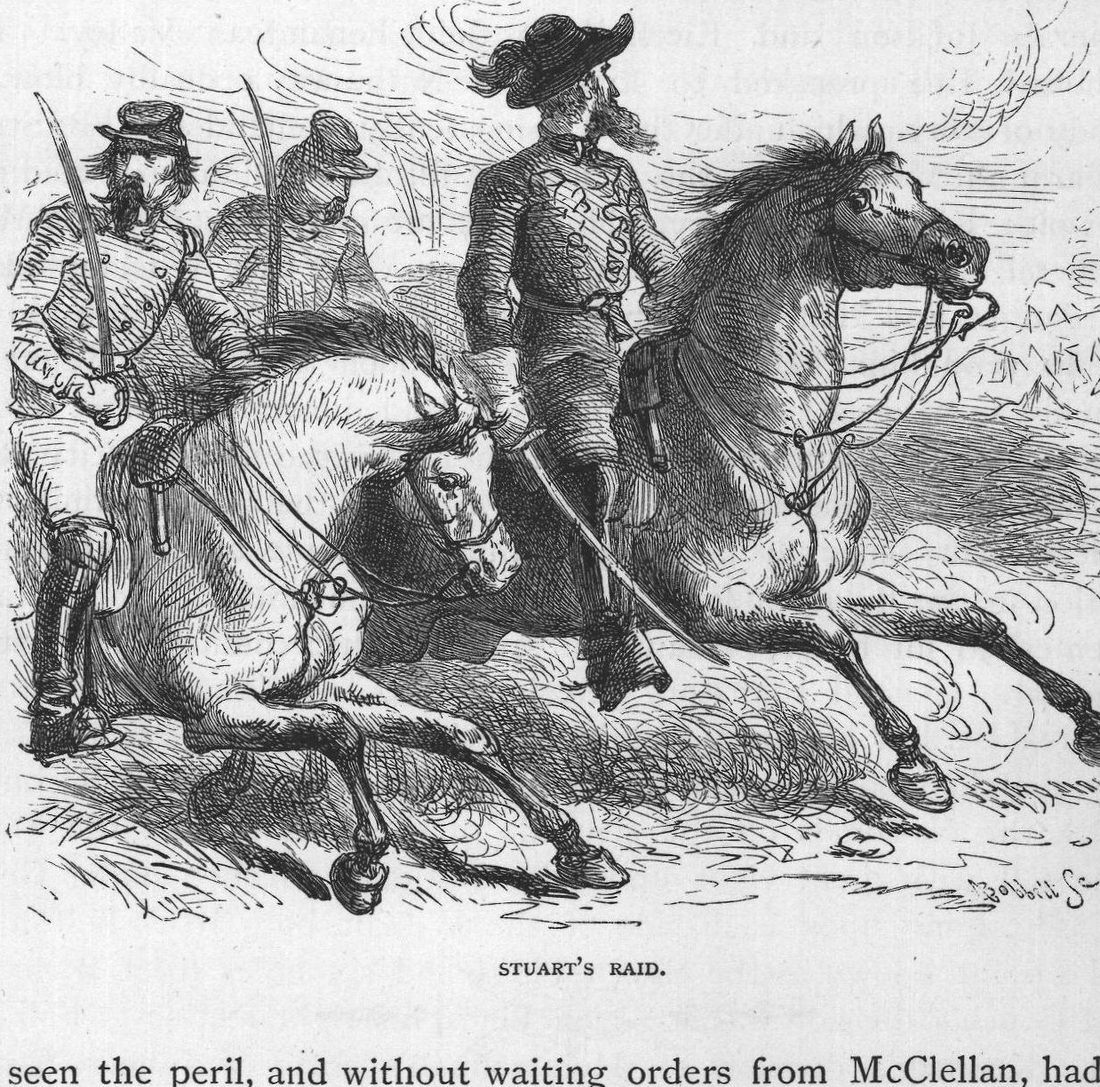
The Army of the Potomac lay on the borders of the Chickahominy, in a most unhealthy position, for nearly a month after the battle of Fair Oaks, quietly besieging Richmond; and the public expectation was continually fed by the frequent announcement that the decisive battle would be fought "to-morrow." General Robert E. Lee had succeeded the wounded Johnston in the command of the Confederate troops, and had been joined by Generals Jackson and Ewell from the Shenandoah Valley. Thus strengthened, Lee prepared to strike the Nationals a deadly blow. A large body of his cavalry under the dashing leader General J.E.B. Stuart, rode all around McClellan's army. He had fifteen hundred mounted men, and four pieces of horse-artillery. He swept around almost to the "White House;" seized and burned fourteen wagons and two schooners laden with forage, in the Pamunkey, above the "White House;" captured and carried away one hundred and sixty-five prisoners and two hundred and sixty mules and horses; rested three hours, and during the night crossed the Chickahominy and returned to Richmond by the Charles City Road, on the morning of the 15th of June. This raid, the first of similar and more destructive ones by both parties during the war, produced great commotion in the Army of the Potomac. In the meantime reinforcements had been called for by McClellan, and sent, yet that commander hesitated to strike.