Arrival of French Forces-Treason of Arnold
As the invaders pushed on toward Springfield, they were met by Max-well's troops, and after a brief skirmish, and hearing that forces were coming down from Morristown, they retreated to the coast, where they remained about a fortnight. Meanwhile Clinton had arrived from Charleston. He sent reinforcements to Mathews, and after making a feint upon the Hudson Highlands, he and Knyphausen crossed over and joined the troops at Elizabethtown Point. The feint deceived Washington, who left the command of a considerable force of Continental troops at the Short Hills, between Springfield and Morristown, with General Greene, while he moved with another force in the direction of the Hudson. Early in the morning of the 23d of June (1780), the British advanced toward Springfield, and Greene moved forward to meet them, in battle array. The invaders approached in two columns. Greene was advantageously posted. The British force, about five thousand strong, with cavalry and almost twenty cannon, seemed sufficient to crush any republican army that might oppose them; but after a very severe skirmish, the invaders were defeated. Setting fire to Springfield, they retreated to the shore, and crossed over in haste from Elizabethtown Point to Staten Island, on a bridge of boats. Clinton had lost a rare opportunity for the conquest of New Jersey, and possibly the destruction or dispersion of Washington's army.
Good news for the Americans now came from the east. The strong recommendations from D'Estaing on his return to France, joined with the persuasions of Lafayette, had induced the French government to send an army to America, under the Count de Rochambeau, who was instructed to act under the orders of Washington at all times, after his arrival. The troops were borne over the Atlantic in a fleet commanded by Admiral de Ternay, and arrived at Newport, Rhode Island, on the 10th of July. The General Assembly of the State were then in session, and received the strangers cordially. The news of their arrival was greeted with joy everywhere in the Union; and Washington sent a letter of welcome to Rochambeau, by the hand of Lafayette, who was instructed to concert measures with the French general for the future operations of the allied armies. In compliment to the strangers and as a symbol of the alliance with them, Washington requested his officers to wear on their chapeaus white and black cockades.
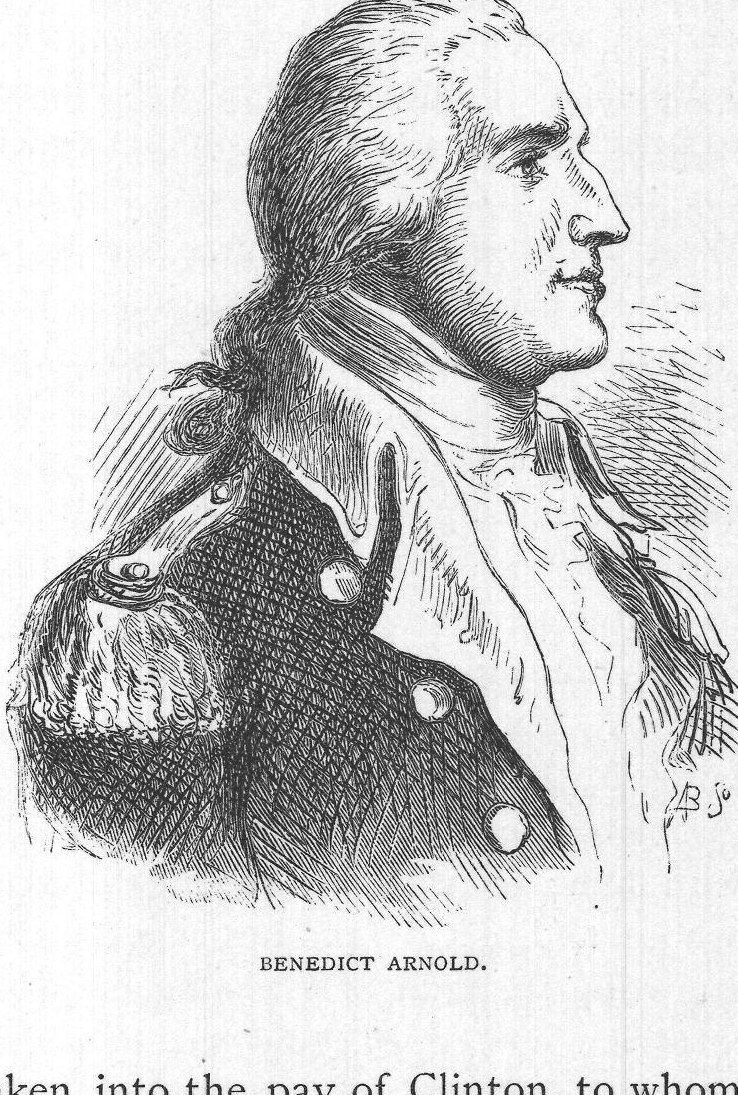
When news of the arrival of the French at Newport reached New York, Clinton ordered the British fleet there to bear an army to Rhode Island to attack the newly arrived enemy. He detached about eight thousand men for that service. The militia of New England flew to arms, and the French longed for the British to come; but the expedition did not go out of Long Island Sound, and soon returned to New York. Clinton now attempted, by the aid of treason, to accomplish what he had failed to do by honorable warfare. The man who played the part of a traitor to the American cause on that occasion was General Benedict Arnold, a brave soldier, but a bad man. He was ambitious of personal renown, impulsive, rapacious, unscrupulous, and vindictive; personally very unpopular, and seldom without a quarrel with some of his fellow-officers. The sad story of his treason has been so often told in detail, that we need to give it in general outline only.
Soon after the appointment to the military governorship of Philadelphia, in 1778, he married the beautiful daughter of Edward Shippen, a leading loyalist of that city. He lived in a style which caused expenditure beyond his income, and to meet the demands of importunate creditors, he engaged in fraudulent and dishonorable official acts which caused the public to detest him. Finally serious charges of dishonesty were preferred against him before the Continental Congress; and a court-martial ordered by that body to try him, found him guilty. In their sentence they treated him most leniently. It was a simple reprimand by the commander-in-chief. That duty was performed by Washington in the most delicate manner; but the disgrace awakened vengeful feelings in the bosom of Arnold. These, operating with the pressure of debt, made him listen to the suggestions of a bad nature; and he let Sir Henry Clinton know that he preferred service in the British army to that in which he was engaged. Correspondence upon the subject, which was continued several months, was conducted on the part of Sir Henry, through the accomplished Major John Andre, his adjutant-general, under an assumed name. So, also, did Arnold assume a fictitious name; and on the part of both, the correspondence was carried on in commercial phraseology. Arnold agreed to ask for the command of the strong post of West Point and its dependencies, in the Hudson Highlands, and, if obtained, to betray it into the hands of Clinton. For this service Arnold was to receive the commission of brigadier in the British army, and fifty thousand dollars in gold. It is asserted by Mr. Bancroft, that "in the course of the winter of 1778-1779, he was taken into the pay of Clinton, to whom he gave on every occasion most material intelligence."