Army Reorganized
Perceiving the peril that awaited them when the canal should be completed, the Confederates sunk steamboats in the channel of the river to prevent gun-boats descending it, and they unsuccessfully attempted to escape from the Island. After the Carondelet had passed the batteries, Beauregard was satisfied that the siege must speedily end in disaster, and he was not disposed to bear the responsibility; so, after turning over the command on the Island to General McCall, and leaving the troops on the Kentucky and Tennessee shores in charge of General McCoun, he, with a considerable number of the best soldiers, departed for Corinth to check a formidable movement of National troops through middle Tennessee toward northern Alabama and Mississippi. McCall, on assuming the command, issued a flaming proclamation; but within thirty-six hours he and his troops prepared to escape from the Island. They were interrupted in their movements by General Pope's forces under Generals Stanley, Hamilton, and Paine; and Island Number Ten, with the troops, batteries and supports on the main, were surrendered to the Nationals on the 8th of April. Over seven thousand men were surrendered prisoners of war; and the spoils of victory were one hundred and twenty-three cannons and mortars, seven thousand small-arms, many hundred horses and mules, four steamboats afloat, and a very large amount of ammunition.
The fall of Island Number Ten was a calamity to the Confederacy from which it never recovered. It produced widespread alarm in the Southern States; for it appeared probable that Memphis, one of their strongholds on the Mississippi, where they had immense workshops and armories, would soon share the fate of Columbus, and that National war-vessels would speedily patrol the great river from Cairo to New Orleans. Martial-law was proclaimed at Memphis, and the specie in the banks there was taken to places of supposed safety. Troops that guarded the city and panic-stricken residents proposed to lay the town in ashes if it could not be saved from "northern invaders." The zeal of these madmen was cooled by the sensible Mayor Park, who publicly proclaimed that "he who attempts to fire his neighbor's house, or even his own whereby it endangers his neighbor's, regardless of judge, jury, or the benefit of clergy, I will have him hung to the first lamp-post, tree, or awning." At Vicksburg, preparations were made for flight, and the disloyal inhabitants of New Orleans were oppressed with fearful forebodings of impending calamity. The governor of Louisiana, who was a leading Secessionist, issued a despairing appeal to the people. "An insolent and powerful foe is already at the castle gate," he said. "The current of the mighty river speaks to us of his fleets advancing for our destruction, and the telegraph wires tremble with the news of his advancing columns. In the name of all most dear to us, I entreat you to go and meet him." But there was little disposition to comply with the governor's wishes; and when a letter from Beauregard, which he sent by his surgeon-general, making an urgent demand for New Orleans to send five thousand troops to him, at once, "to save the city," was read to the First and Second City Brigades, who were called out, their reply was, "We decline to go." Their city then needed defenders below instead of above it.
It seemed as if the plan devised by Fremont was about to be successfully carried out. Curtis had already broken the military power of the Confederacy west of the Mississippi, at the battle of Pea Ridge; and a heavy force was then making its way up the Tennessee toward Alabama and Mississippi, and had, at the moment of the surrender of the famous Island, achieved a most important victory on the left bank of that stream not a score of miles from Corinth. Curtis, after the battle and the flight of the vanquished Confederates, finding no enemy to fight in that region, gave his army ample time to rest, and then marched in a southeasterly direction toward the Mississippi River and encamped at Batesville, the capital of Independence county, Arkansas, on the White River.
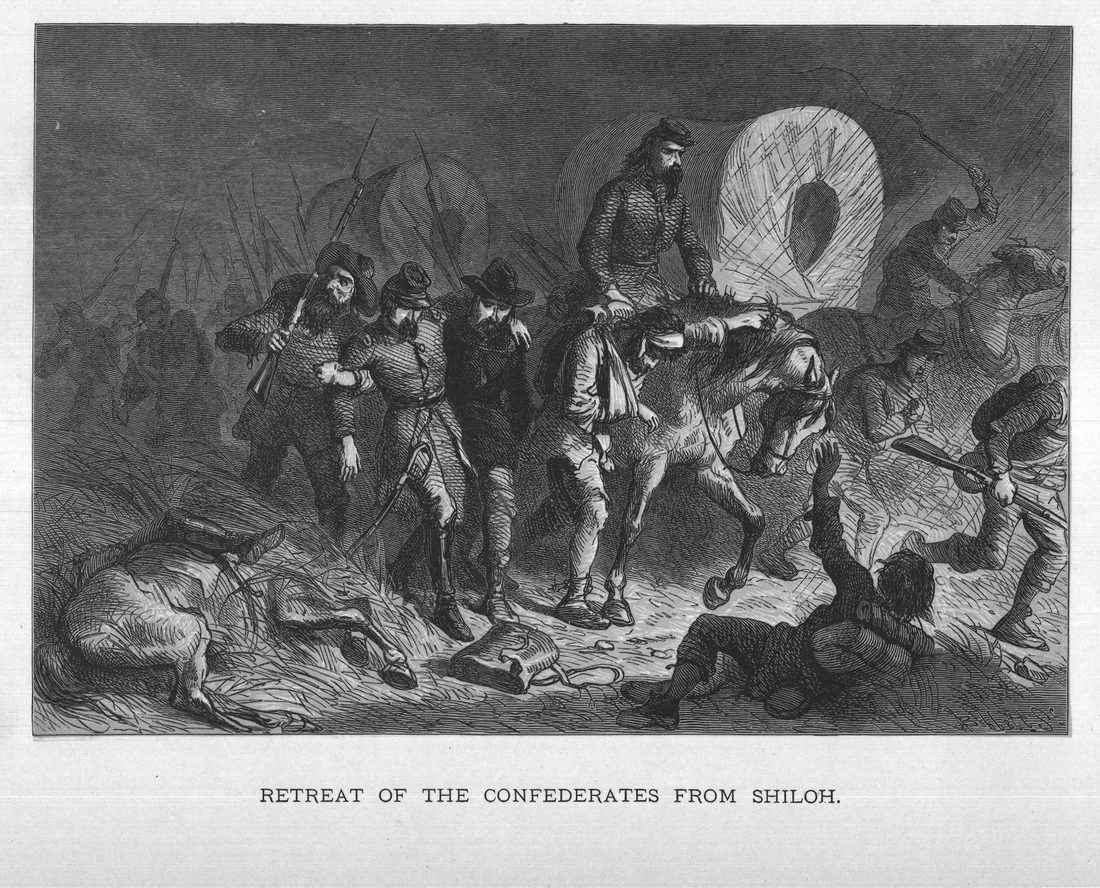
After the capture of Fort Donelson, General Grant had prepared to push toward Corinth, an important position on the line of the Charleston and Memphis Railway. Troops had been sent up the Tennessee River; and finally, at the beginning of April, the main body of Grant's army were encamped between Pittsburgh Landing, on the left bank of that stream, and the Shiloh Meeting-House, the latter in the forest two miles from the river. The grand objective was Corinth. There the Mobile and Ohio Railway intersected the Charleston and Memphis roads. The seizure of that point, as a strategic position of vital importance, was Grant's design. It would give the National forces control of the great railway communication between the Mississippi and the East, and the border slave-labor States and the Gulf of Mexico. It would also facilitate the capture of Memphis, toward the accomplishment of which Foote was now bending his energies, and it would add strength to the movements of Curtis in Arkansas.
In the meantime General Buell's army had slowly made preparations to march southward and join Grant's forces, which were, at first, encamped at Savannah, on the right bank of the Tennessee; but it was not until near the close of March, when Grant's position had become really perilous, that Buell left Nashville. He sent part of his force under General Mitchel in the direction of Huntsville, in northern Alabama, to seize and hold the Charleston and Memphis Railway; while the main body, composed of the divisions of Generals Thomas, McCook, Nelson, Crittenden and T. J. Wood, moved more to the westward by way of Columbia, at which place the troops left the railway and marched slowly toward the Tennessee River.