Another Invasion of Missouri and its Results: Bermuda Hundred and City Point
On the 12th, another sanguinary battle was opened. General Hancock, after the most gallant struggle, broke through the Confederate line and gained a great advantage; but the fierce conflict continued until twilight, and did not entirely cease until midnight, when Lee suddenly withdrew behind a second line of intrenchments, and appeared as strong as ever. Yet Grant, stubborn and bold, was not disheartened. He sent cheering despatches to the government; and pressing forward, fought another desperate battle on the Ny, not far from Spottsylvania Court-House. Lee was repulsed. Grant's flanking movement was temporarily checked, but he speedily resumed it. The losses on both sides, during about a fortnight, had been fearful. That of the Army of the Potomac was about forty thousand men, killed, wounded, and prisoners; and that of the Army of Northern Virginia was about thirty thousand.
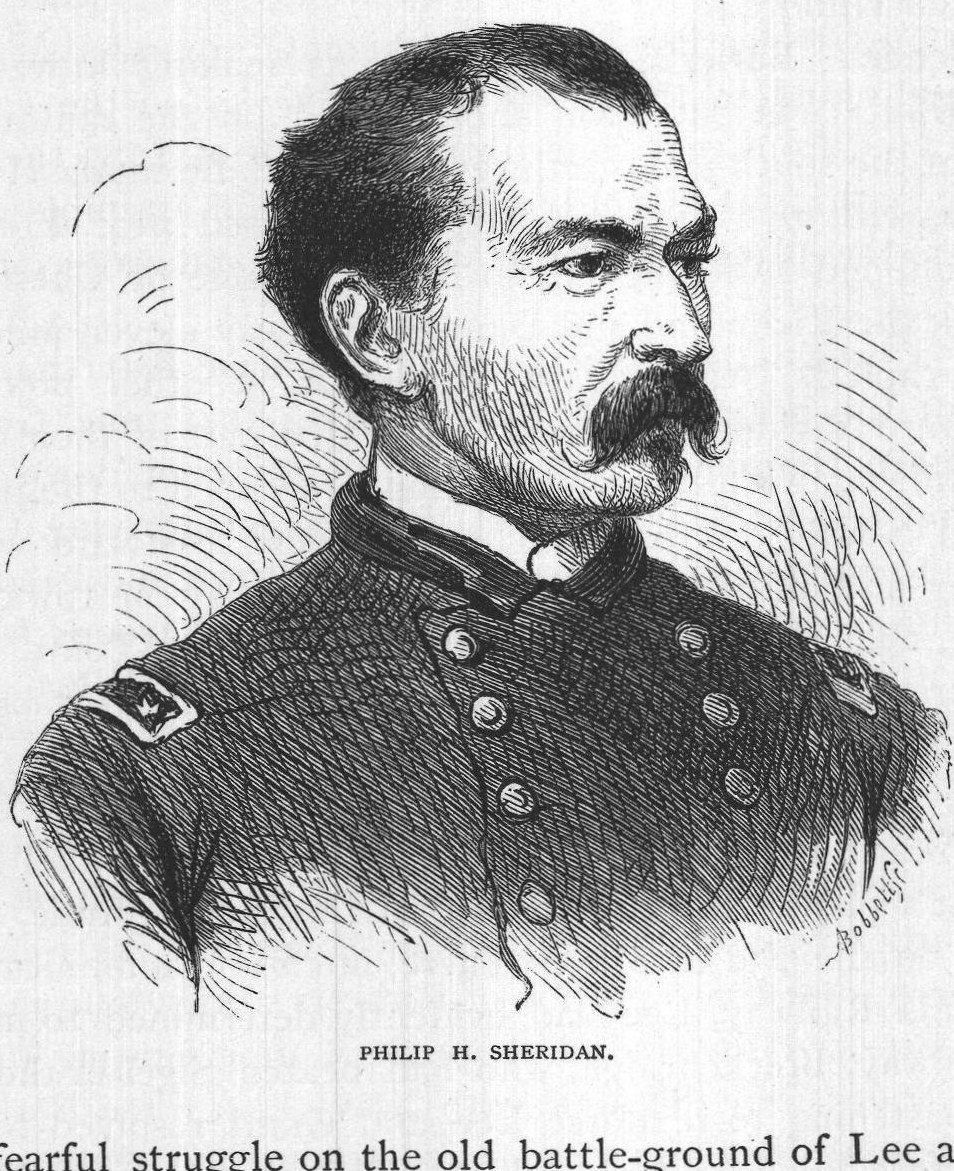
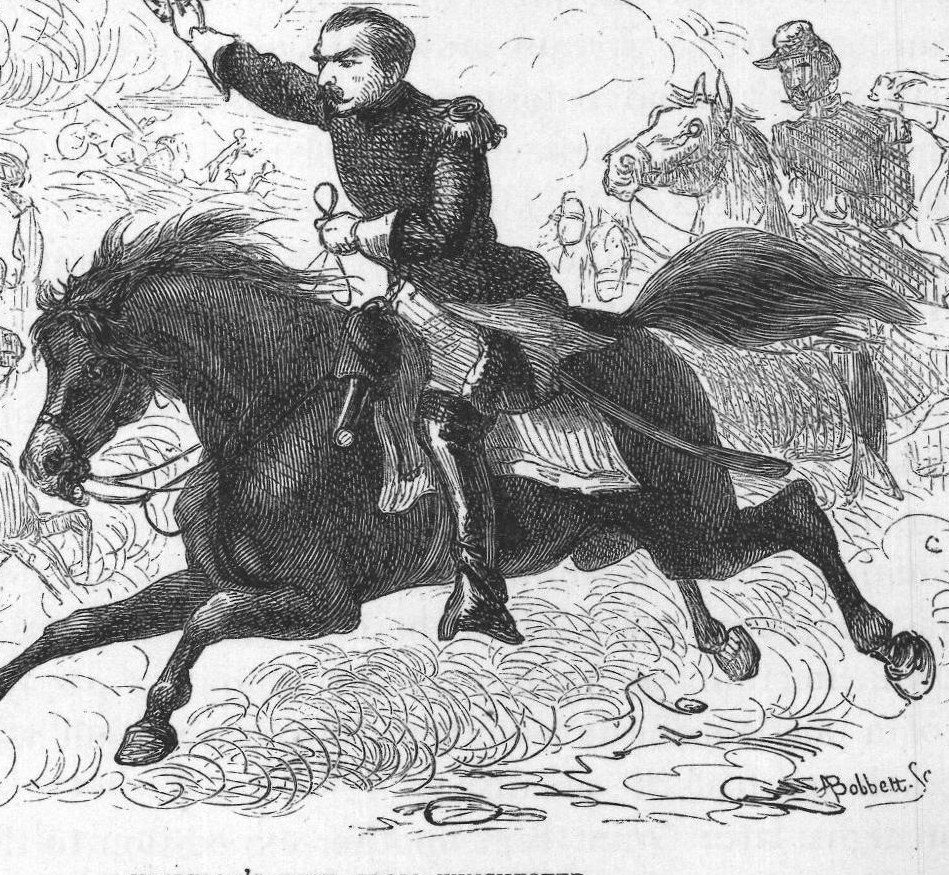
In the meantime, General Sheridan had been raiding in Lee's rear with a greater part of the National cavalry. Like Kilpatrick, he swept down into the Confederate outworks at Richmond, but with more successful results, for he destroyed the railway communication between Lee's army and that city. At the same time there was a co-operating force in the Shenandoah Valley, first under General Sigel and then under General Hunter; but they did not accomplish much of importance besides destroying a vast amount of property. There was another co-operating force below Richmond, commanded by General Butler. He had been joined by Gillmore's troops, which had been ordered up from Charleston; and with about twenty-five thousand men he went up the James River in armed transports, seized City Point at the mouth of the Appomattox River, and took possession of the Peninsula of Bermuda Hundred. He cast up a line of intrenchments across it from the Appomattox to the James, and destroyed the railway between Petersburg and Richmond, so cutting off direct communication between the Confederate capital and the South. At the same time, General A. V. Kautz went up from Suffolk with three thousand cavalry, to destroy the railways south and west from Petersburg; but before he struck them, Beauregard, who had been called from Charleston, had filled that city with defenders. The withdrawal of Gillmore's troops relieved Charleston of immediate danger; and when Butler went up the James, Beauregard was summoned to Richmond. At Petersburg he received hourly reinforcements, and some of them he massed in front of Butler's forces, along the line of the railway. Finally, on the morning of the 16th of May, while a dense fog brooded over the country, he attempted to turn Butler's right flank. A sharp conflict ensued, in which the Nationals had about four thousand men engaged, and the Confederates about three thousand. It ended by the retirement of Butler's forces within their intrenchments. For several days afterward there was considerable skirmishing in front of Butler's lines, when he received orders to send nearly two-thirds of his effective men to the north side of the James River to assist the army contending with Lee in the vicinity of the Chickahominy. Butler complied with the requisition, which deprived him of all power to make further offensive movements. "The necessities of the Army of the Potomac," he said, "have bottled me up at Bermuda Hundred."
While General Butler's main army was making movements toward Richmond, Kautz was out upon another raid on the railways leading to that city from the south and southwest. He left Bermuda Hundred on the 12th of May, with two mounted brigades; passed near Fort Darling, on Drewry's Bluff, and sweeping on an arc of a circle by Chesterfield Court-House, struck the Richmond and Danville Railway eleven miles west of the Confederate capital. After again striking it at other points, he swept around eastward, divided his forces, and with a part of them crossed to the Southside Railway, while another portion proceeded to the junction of the Danville and Southside roads. Then he went eastward with his whole force, striking and destroying the Weldon Railway far toward the North Carolina line, and then made his way back to City Point. In this raid Kautz had seriously damaged the railroads that lay in his track, and took to City Point one hundred and fifty prisoners.
After the struggles near Spottsylvania Court-House, Grant moved steadily on toward Richmond, while Lee moved on a parallel line to thwart his antagonist's plans. At the passage of the North Anne, they fought a severe battle on the 23d of May. There, in close communication with the Central Virginia Railway, Lee had evidently determined to make a stand. Over that railway, Breckenridge, who had beaten Sigel in the Shenandoah Valley, was hastening to reinforce Lee, and Grant resolved to dislodge his antagonist before aid should reach him. This was accomplished, when Lee withdrew to a stronger position where Grant did not attack him. The Army of the Potomac pressed steadily forward, with Sheridan's cavalry in the advance, and on the 28th of May, the entire force of the Nationals were south of the Pamunkey River, with an uninterrupted communication with their new base of supplies at the ruins of the "White House" near the mouth of that stream. Lee had moved by a shorter road, and occupied a strong position on the Chickahominy River, which commanded a turnpike and two railways that led to Richmond.