Another Invasion of Canada Planned
At noon on the 28th, six British armed vessels and forty bateaux appeared off Sackett's Harbor, bearing over a thousand land troops, the whole armament under the command of Sir George Prevost. The troops were embarked in the bateaux, but were soon ordered back, when the whole squadron put to sea. Sir George had been alarmed by the appearance of a flotilla of American gun-boats approaching from the westward conveying a part of a regiment from Oswego to join the garrison at Sackett's Harbor. As soon as their real weakness was perceived, the prows of the squadron were again turned toward the Harbor, and on the morning of the 29th a considerable force, with cannon and muskets, landed on Horse Island. The militia had been withdrawn from the island, and placed behind a gravelridge on the main. These fled almost at the first fire of the enemy. This disgraceful conduct astonished General Brown, and he attempted to rally the fugitives. Colonel Backus, with his regulars and Albany volunters, were disputing the advance of the enemy inch by inch, and a heavy gun from Fort Tompkins played upon the British. At that moment a dense smoke arose in the rear of the Americans. The store-houses, in which was gathered an immense amount of materials, and the ship on the stocks, had been fired by the officer in charge, under the impression, when the militia fled, that the post would be captured. The sight was disheartening; but when Brown was assured that the incendiary was a friend, he felt a relief and redoubled his exertions to rally the militia. He succeeded, and so turned the fortunes of the day in favor of his country. Sir George Prevost, mounting a high stump and sweeping the horizon with his field-glass, saw the rallying militia on his flank and rear, and supposing these to be reinforcements of regulars in large numbers, sounded a retreat. That movement became a disorderly flight. The British troops reached the squadron in safety, leaving their dead and wounded behind. At noon the whole armament sailed away, and Sackett's Harbor was saved. So also was the ship on the stocks; but a half million dollars worth of stores were destroyed. Sackett's Harbor was never afterward attacked, and it remained the chief place of deposit for supplies for the northern frontier during the war.
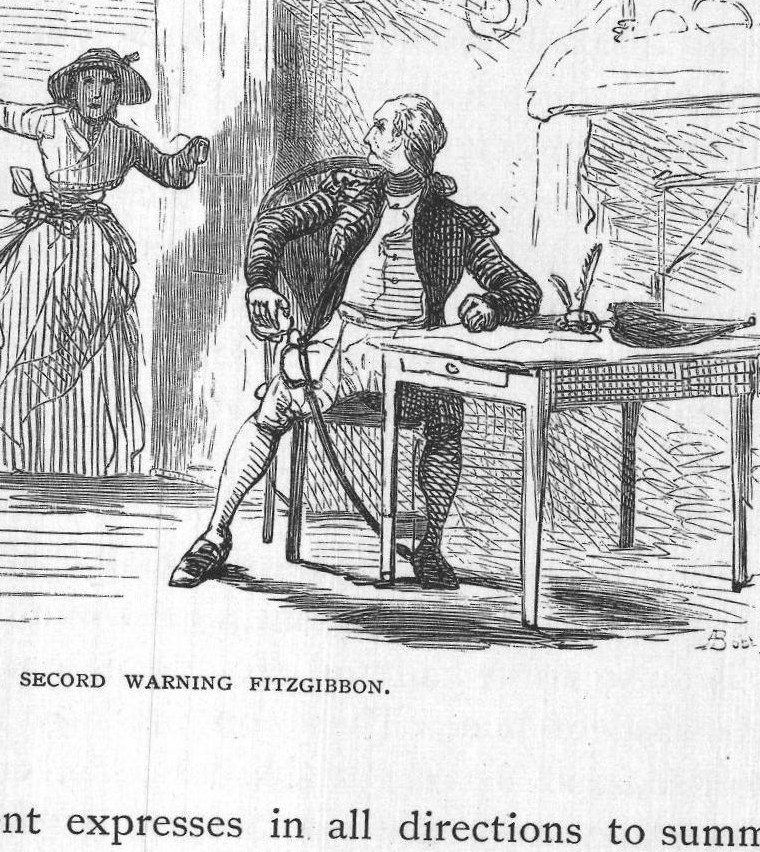
We left the Americans on the Niagara frontier, at Fort George. The British advance-post was then at the Beaver Dams, and General Dearborn sent Lieutenant-Colonel Boerstler, with about six hundred men and two field-pieces, to capture the garrison and a large amount of stores collected there. It proved to be a most unfortunate undertaking. Mrs. Laura Secord, a light and delicate woman living at Queenstown, became acquainted with Dearborn's plan, and on a hot summer day on the 23d of June, she made a circuitous journey of nineteen miles on foot to the quarters of Lieutenant Fitzgibbon, who was at the Beaver Dams with some regulars, and informed him of his danger. When, on the following day, Boerstler penetrated that region, he was assailed by Indians under John Brant and others, and by an exaggerated statement of the strength of the British in that neighborhood, was induced to surrender his whole command. The British then advanced to Queenstown, and very soon invested Fort George with a strong force. Dearborn, whose career as commander-in-chief of the army had been singularly unsuccessful, was now succeeded by General James Wilkinson. The change was of no value to the American cause. Dearborn withdrew from the service before the arrival of Wilkinson, leaving the command of the Americans at Fort George with General John Boyd, the senior officer on that frontier.
Thus far all attempts to conquer Canada had failed. The invasions were unsuccessful, yet the government did not seem to have gained wisdom by experience. The Secretary of War, General Armstrong, was as much infatuated with this idea as his predecessors had been, and he now conceived a plan for making an invasion of that province by the united forces of the armies of the centre and of the north; and on the arrival of Wilkinson from the command of the Gulf regions, he was ordered to Sackett's Harbor to make arrangements for the future. He differed with Armstrong about the plan of the new invasion, and bitter enmity between them was soon aroused. The fiery spirit of Armstrong could not brook contradiction. There was another fiery spirit then in the field-General Wade Hampton of South Carolina, one of Marion's companions in arms, who had succeeded Bloomfield in command of the Northern Department. He was a thorough-going aristocrat, whose landed possessions in his native State and in Louisiana were almost princely in extent, and he counted his slaves by thousands. He hated Wilkinson intensely; and when that officer, on his arrival at Albany, sent his first order to Hampton, the anger of the veteran was fiercely kindled. He wrote to the Secretary of War, insisting that his was a separate command, and tendering his resignation in the event of his being ordered to act under Wilkinson. The latter, at the same time, was as jealous of Armstrong, whom he feared might trample upon his prerogatives; and on the 24th of August (1813), he wrote to the Secretary: "I trust you will not interfere with my arrangements, or give orders within the district of my command, but to myself, because it would impair my authority and distract the public service. Two heads on the same shoulder make a monster."