Americans Repulsed
The colonial post-office system had been broken up by the public disorders, and on the 26th of July (1775) the Congress made provision for a new one, and appointed Dr. Franklin postmaster-general. From that office he had been dismissed by the British government the year before, as we have observed. Very little else was done during the year toward organizing civil government, for military affairs occupied almost the whole attention of the Congress. They established a general hospital, and appointed the unworthy Dr. Benjamin Church as chief director. Soon after his appointment, he was detected in holding secret correspondence with General Gage. He was immediately expelled from every position of trust which he held, and by order of the Continental Congress was lodged in the Norwich (Connecticut) jail. His health failing, he was allowed to leave the country for the West Indies. The vessel in which he sailed was never heard of afterward. So perished the first traitor to the American cause. Dr. John Morgan took his place at the head of the hospital.
The army before Boston received the special attention of the Congress. The term of enlistment of all the troops would expire with the year, and Washington foresaw the dissolution of his forces then. He asked the Congress to assist him in providing plans for preventing such a fatal disaster. They sent a committee composed of Dr. Franklin, Thomas Lynch, and Benjamin Harrison to the camp at Cambridge for the purpose, and at the headquarters of Washington they opened their conference with the commander-in-chief on the 18th of October. There they were joined by delegates from the several New England colonies, and in the course of a few days they matured a plan that was satisfactory to Washington, and was effectual.
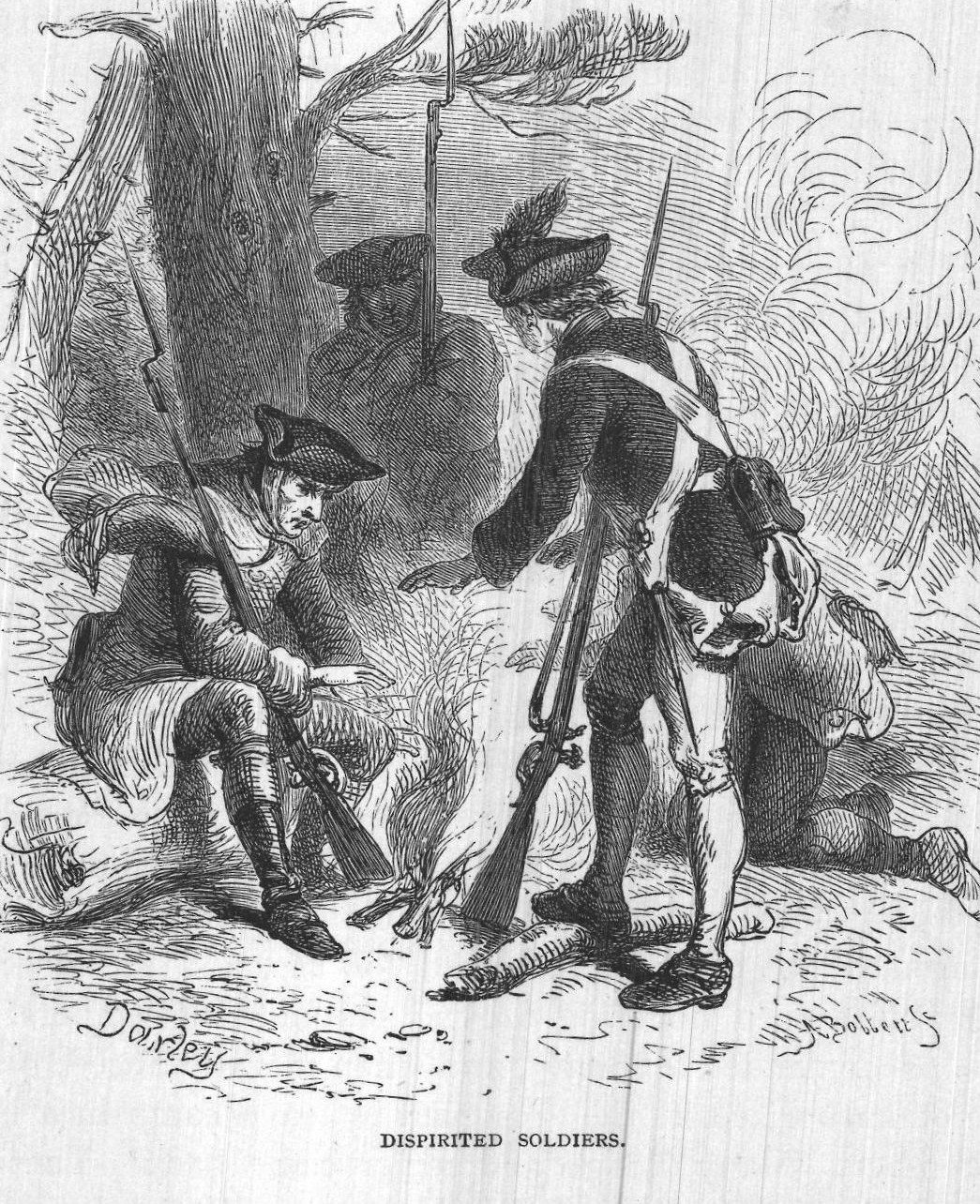
For a long time the army was not only weak in numbers, but feeble in moral strength and material supplies. In August it was discovered that the supply of gunpowder was not sufficient for nine rounds to each man, and other munitions were lacking in the same proportion. For months the American army was compelled to play the part of jailer to the British troops in Boston. It was even difficult to sustain that part; and had the royal forces known the real impotence of their jailers, they might have burst their prison doors with impunity, and scattered the republican army to the winds. In the individuality--the self-assertion of each soldier--to which allusion has been made, was found moral weakness as regarded the strength of discipline. Each man had left his home to fight for freedom, and was disposed to first assert it in his own behalf. The consequence was general insubordination, which had to be humored until the common sense and experience of the soldier taught him the value and necessity of discipline. Washington managed this matter with great tact, and accomplished, by argument and persuasion, that which he could not have gained by force.
Comparative inaction marked the siege of Boston for several months. There was some cannonading in August when General Sullivan, in imitation of Prescott, cast up a redoubt in a single night upon an eminence within cannon-shot of Bunker's Hill. Three hundred shells were thrown upon this redoubt from Bunker's Hill and British shipping with very little effect. There were occasional skirmishes between republican detachments and royal foragers on the islands in Boston harbor and the shores of the main, but there was no serious engagement. Washington tried to bring on one by various challenges. He did not feel strong enough to attack his foe, but he was ready to meet any sortie or sallying-out the British troops might make. But Gage was too prudent to attempt another excursion into the country. He contented himself with threats; in the sending out of alarming stories about Russian and German troops coming to help the British, and in treating the few whigs who remained in Boston in a barbarous manner. Gage was called to England, in October, to answer for his inefficiency, when General Howe assumed the chief command of the British army in America. Howe strengthened his defences, and increased the number of British cruisers sent out to harass the coast towns of New England, hoping thereby to cause Washington to weaken his besieging army by sending detachments for the relief of the distressed regions. Falmouth (now Portland, Maine,) was burned in October, and other towns were sorely smitten by the marauders. These acts failed to draw a regiment away from Cambridge, but caused a swarm of American privateers to appear upon the waters. Captain Manly, in a vessel sent out by Washington to intercept supply-vessels bound for Boston, maintained a position off the harbor of the New England capital for some time, and made three important captures. One of his prizes contained heavy guns, mortars, and intrenching tools; the very things most needed by the Americans at that time.
Howe imitated Gage in treating the open whigs and suspected persons in Boston with harshness. His excuse was that they were active, though secret, enemies, keeping up a communication with the "rebels" either by personal intercourse, or by signals from church steeples and other high places. He forbade all persons leaving the city without permission, under pain of military execution; and he ordered all of the inhabitants to associate themselves into military companies.