American Affairs in Europe: Preston and Attucks
The populace immediately echoed the shout--"To the main-guard!" with fearful vehemence, and separating into three ranks, took different routes toward the quarters of the main-guard. While one division was passing the Custom-house, the barber's boy cried out: "There's the scoundrel who knocked me down!" A score of voices shouted, "Let us knock him down! Down with the bloody-backs! Kill him! kill him!" The crowd instantly began pelting him with snow-balls and bits of ice, and pressed toward him. He raised his musket and pulled the trigger. Fortunately for him it missed fire, when the crowd tried to seize him. He ran up the Custom-house steps, but, unable to enter the building, he called to the main-guard for help. Captain Preston, the officer of the day, sent eight men, with unloaded muskets but with ball-cartridges in their cartouch boxes, to help their beleaguered comrade. At that moment the stout Boston bookseller, Henry Knox (who married the daughter of General Gage's secretary and was a major-general of artillery in the army of the Revolution), holding Preston by the coat, begged him to call the soldiers back. "If they fire," said Knox, "your life must answer for the consequences." Preston nervously answered: "I know what I am about," and followed his men.
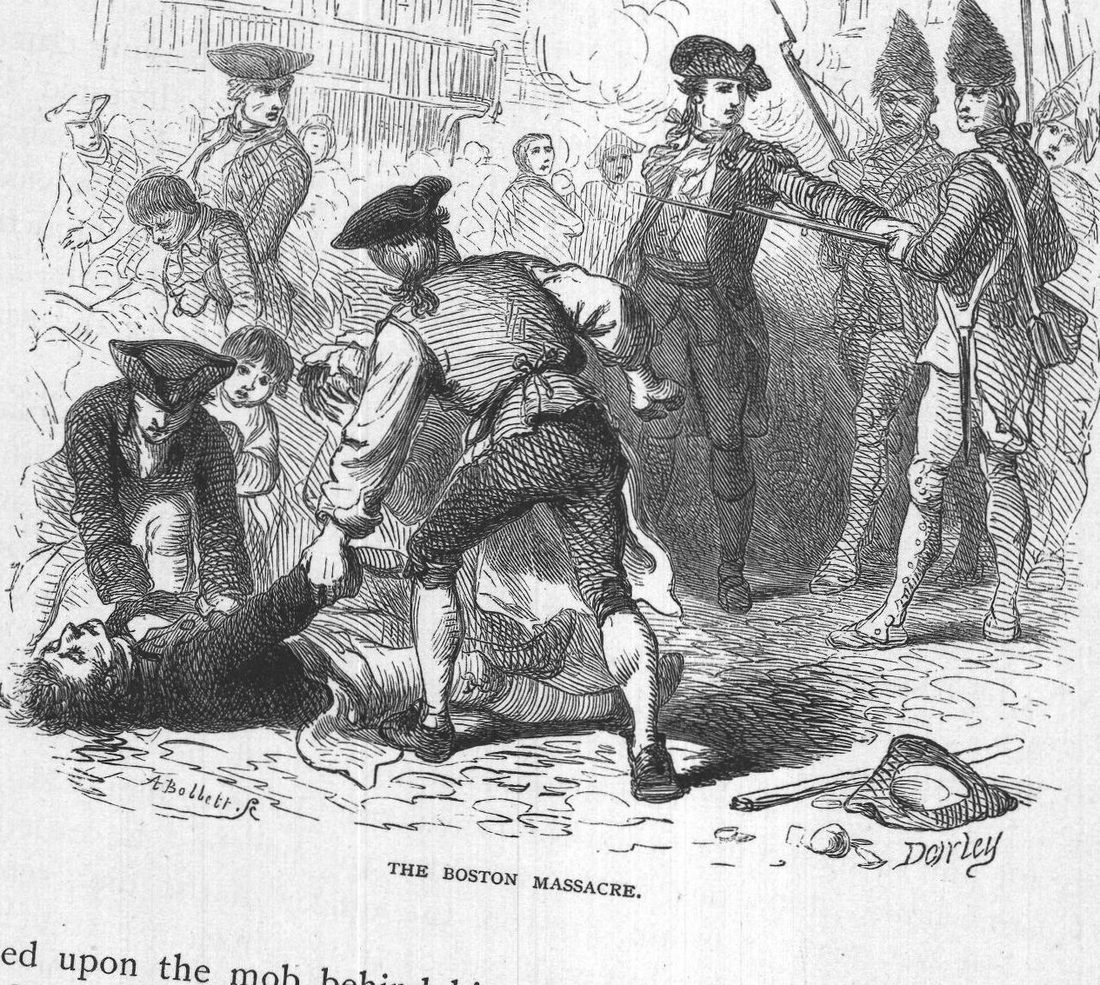
When this detachment approached, they, too, were pelted with snow-balls and ice; and Crispus Attucks, a brawny Indian from Nantucket, at the head of some sailors, like himself (who had led the mob in the attack on the soldiers in Dock Square), gave a loud war-whoop and shouted: "Let us fall upon the nest! the main-guard! the main-guard!" The soldiers instantly loaded their guns. Then some of the multitude pressed on them with clubs, struck their muskets and cried out, "You are cowardly rascals for bringing arms against naked men." Attuck shouted: "You dare not fire!" and called upon the mob behind him: "Come on! don't be afraid! They daren't fire! Knock them down! Kill 'em!" Captain Preston came up at that moment and tried to appease the multitude. Attucks aimed a blow at his head with a club, which Preston parried with his arm. It fell upon the musket of one of the soldiers and knocked it to the ground. Attucks seized the bayonet, and a struggle between the Indian and the soldier for the possession of the gun ensued. Voices behind Preston cried out, "Why don't you fire! why don't you fire?" The struggling soldier hearing the word fire, just as he gained possession of his musket, drew up his piece and shot Attucks dead. Five other soldiers fired at short intervals, without being restrained by Preston. Three of the populace were killed, five were severely wounded (two of them mortally), and three were slightly hurt. Of the eleven, only one (Attucks) had actually taken part in the disturbance. The crowd dispersed; and when citizens came to pick up the dead, the infuriated soldiers would have shot them, if the captain had not restrained them.
News of the tragedy spread over the town in a few minutes. It was now near midnight. There was a light in every house, for few besides children had retired on that fearful night in Boston. The alarm-bells were rung. Drums beat to arms. A cry went through the streets--"The soldiers are murdering the people! To arms! to arms! Turn out with your guns!" Preston also ordered his drums to beat to arms. Colonel Dalrymple, with the lieutenant-governor, were soon on the spot and promised the orderly citizens, who had taken the place of the dispersed mob, that justice should be vindicated in the morning. Order was restored, and before the dawn the streets of Boston were quiet. Meanwhile Preston had been arrested and put into prison; and the next morning the eight soldiers were committed--all charged with the crime of murder.
Such is the sad story of the famous "Boston Massacre," gleaned from the conflicting evidence of witnesses at the trial of Preston and his men, and of contemporary writers. The 5th of March was celebrated as a solemn anniversary in the history of the colonies, until after the Declaration of Independence became a national holiday. The killing of citizens was undoubtedly a massacre, for the outrageous conduct of the soldiers created the mob. Their offensive acts on that night were undoubtedly approved by Dalrymple, their commander. It was his duty to keep them in the barracks at a time of popular excitement only, not an insurrection. He must have foreseen the result of their doings, and hoped for an excuse to "begin work in Boston," as he had said before. Such is the verdict of history after a lapse of more than a century.
The event produced a profound impression everywhere. The cause of Boston became the cause of the continent. The story, embellished in its course from lip to lip, became a tale of horrors that stirred the blood of patriots everywhere. It was a crisis in the history of the colonies. Some were disposed to consider the events on that night as forming the principal cause of the Revolution which soon afterward broke out. John Adams said long years afterward: "On that night the foundation of American independence was laid;" and Daniel Webster, when speaking of the event, said: "From that moment we may date the severance of the British empire." The "foundation for the independence of America" was laid long before, when the early colonists began to yearn for the privileges of local self-government; and the "severance of the British empire" was decreed when Andros was driven from New England.