Accession of George the Third: Charles Townshend and Grenville
Charles Townshend, who had been Secretary of War, was made First Lord of Trade two months before Grenville became Premier. He was a thorough aristocrat and stickler for the royal prerogative, and was disposed to act with more rigor in restraining popular liberty in America than any of his predecessors. He advocated the substitution of royal authority for the colonial charters, and a new territorial arrangement of the provinces. The conclusion of peace with France, then very near, was to be the time when these vigorous measures against the Americans were to be put into operation; and as preliminary thereto, Townshend proposed making crown officers in the colonies independent of the people for their salaries, and maintaining a standing army there at the expense of the inhabitants for their own subjugation. He also proposed a stamp tax, which Bute had suggested to Parliament on the recommendation of his secretary Charles Jenkinson; and when, soon afterward, Jenkinson became Secretary of the Treasury, he proposed the measure to Grenville. The latter, at about the same time, with short-sightedness equal to Townshend's, introduced a bill for enforcing the navigation laws, which empowered every officer and seaman of the British navy to act as custom-house officers and informers, and so subjecting to search and seizure every American vessel on sea or in port. These measures for enslaving and plundering the colonists were proposed, and partially put into operation, at the moment when peace was established and the loyal colonies were rejoicing because of the honor and dominion which the war just ended had won for the British crown. Otis, at a town-meeting in Boston, expressed the feelings of the Americans, when he said: "We in America have abundant reason to rejoice. The heathen are driven out and the Canadians conquered. The British dominion now extends from sea to sea, and from the great rivers to the ends of the earth. Liberty and knowledge, civil and religious, will be co-extended, improved and preserved to the latest posterity. No constitution of government has appeared in the world so admirably adapted to these great purposes as that of Great Britain. Every British subject in America is, of common right, by act of Parliament, and by the laws of God and nature, entitled to all the essential privileges of Britons. By particular charters particular privileges are justly granted, in consideration of undertaking to begin so glorious an empire as British America. Some weak and wicked minds have endeavored to infuse jealousies with regard to the colonies; the true interests of Great Britain and her plantations are mutual, and what God in his providence has united, let no man dare attempt to pull asunder." These words rebuked the Lords of Trade, who were continually assailing the royal ear with stories about the aspirations of the American colonies for absolute independence; and they were also a significant demand upon Charles Townshend to keep his hands off the American charters.
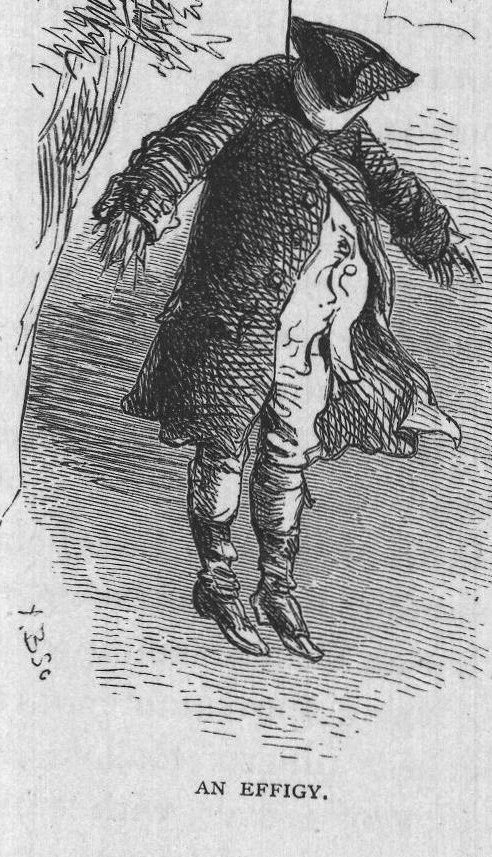
In the spring of 1764, Grenville read, in the House of Commons, a series of resolutions declaring the intention of the government to raise a tax in America by a duty on stamped paper. A stamp duty had been proposed in 1732, during Walpole's administration, but that sagacious minister said: "I will leave the taxation of America to some of my successors, who have more courage than I have." Sir William Keith, governor of Pennsylvania, proposed such a tax in 1739. Franklin thought it just, when in the convention at Albany in 1754. But when it was proposed to Pitt in 1759, he said: "I will never burn my fingers with an American stamp act." Early in 1764, Mr. Huske, a native of Portsmouth, New Hampshire, then residing in England, and holding a seat in Parliament, desirous of showing his excessive loyalty, arose in his place, alluded to Franklin's opinion in the Albany convention, and delighted the House of Commons with the assurance that the Americans were able to pay a liberal tax. He recommended that one should be levied that would amount annually to two and a half million dollars. Encouraged by these precedents and this assurance, Grenville, a few weeks afterward (March 9, 1764), presented his Stamp Act scheme, asking for a million dollars. On his own motion the consideration of it was postponed, and it slept for almost a year. For the part which he played in the matter, John Huske incurred the hot resentment of his countrymen, and he was hung in effigy on "Liberty Tree" in Boston, with the following inscription on his breast:
Answer. Ah, indeed ! but I'm a wicked lad;
My mother always thought me wild;
`The gallows is thy portion, child,'
She often said; behold, 'tis true,
And now the dog must have his due;
For idle gewgaws, wretched pelf,
I sold my country, d--d myself;
And for my great, unequalled crime,
The d--I takes H--e before his time.
But if some brethren I could name,
Who shared the crime should share the shame,
This glorious tree, though big and tall,
Indeed would never hold 'em all."