A "Presidential Year"
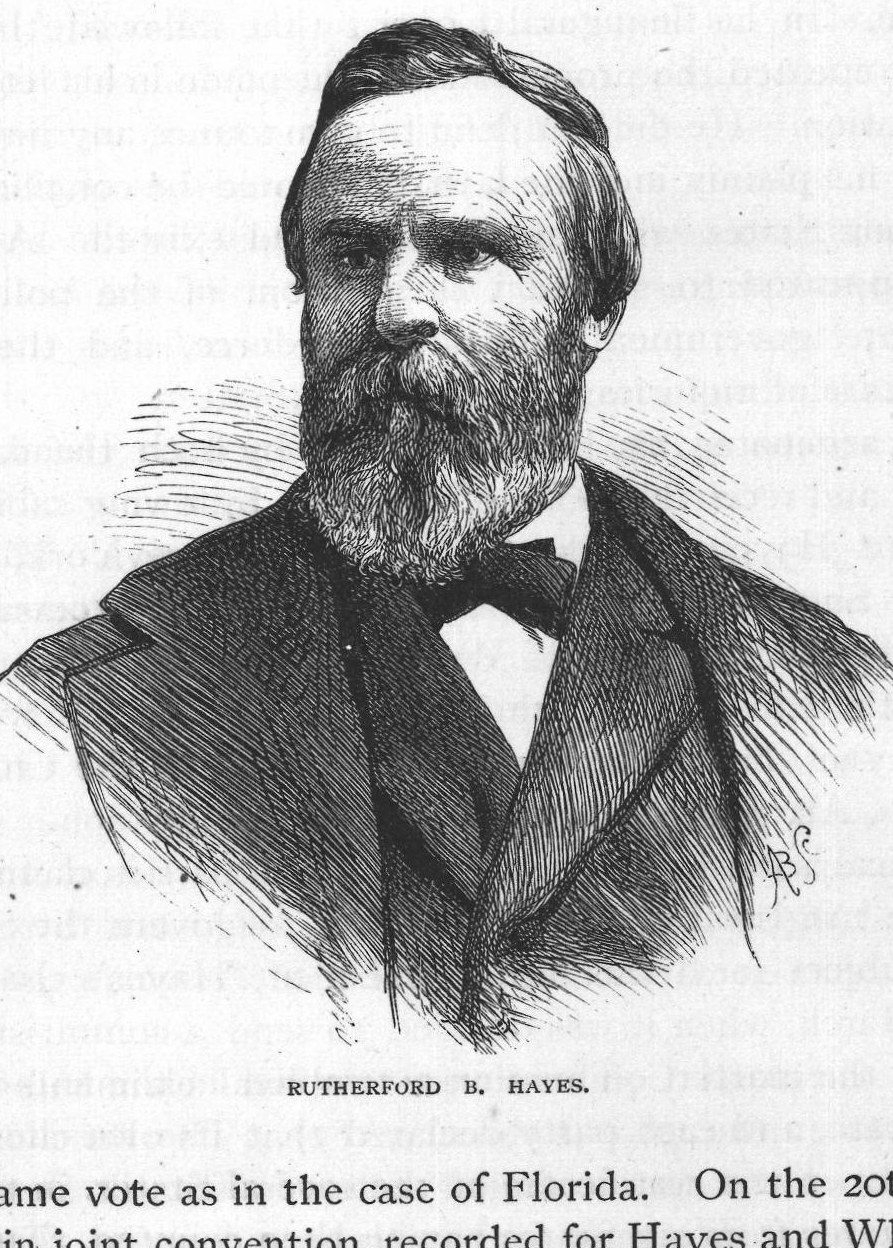
We have observed that 1876 was a "Presidential year" as well as a "Centennial year." The campaign for the prize of the Presidency of the Republic was vigorously begun at the middle of June, when a Republican National Convention assembled (June 16) at Cincinnati, to make nominations for President and Vice-President. There were two prominent candidates before the Convention, James G. Blaine of Maine, and Roscoe Conkling of New York. They were both rejected, and the Convention nominated Rutherford Birchard Hayes, at that time governor of Ohio, for the Presidency, and William A Wheeler of New York, for the Vice-Presidency. On the 27th of the same month a Democratic National Convention assembled at St. Louis for the same purpose, and nominated Samuel J. Tilden (then governor) of New York, for President, and Thomas A. Hendricks of Indiana, for Vice-President. A most exciting canvass ensued, during which the lawlessness that disturbed portions of some of the Southern States, was reproduced with increased vehemence, and at times local civil war seemed to be inevitable.
In South Carolina bands of lawless armed men, countenanced by some of the leading politicians, patrolled the election districts in that State for the purpose of intimidating their political opponents and keeping them from the polls. They dispersed political gatherings and silenced public speakers by their presence and threats. It became evident that the majority of the citizens of that State would be deprived of the privilege of the elective franchise at the approaching election, and on the the 17th of October (1876) President Grant issued a proclamation commanding the "rifle clubs" of South Carolina to disperse within three days. On the same day the Secretary of War issued an order to the General-in-Chief to direct all of the available forces in the Military Division of the Atlantic, to report to the commanding general at the State capital of South Carolina, to carry into effect the President's proclamation.
The result of the Presidential election was long in doubt, each party claiming a majority for its candidate. One hundred and eighty-five votes in the electoral college was necessary to the success of a candidate. It was decided, immediately after the election, that Mr. Tilden had one hundred and eighty-four. Democratic Presidential Electors had been chosen in three Northern States--New York, New Jersey, and Connecticut; in one of the Western States--Indiana; and in all the Southern States except South Carolina, Florida, and Louisiana. The Republican Electors had been chosen in six Northern States--Maine, Massachusetts, New Hampshire, Pennsylvania, Rhode Island, and Vermont; in eleven Western States--California, Illinois, Iowa, Kansas, Michigan, Minnesota, Nebraska, Nevada, Ohio, Oregon, and Wisconsin; and in one Southern State--South Carolina--giving Hayes 173 votes.
Then ensued a long, bitter, and sometimes violent contest in South Carolina, Florida, and Louisiana, over the official returns of the elections. Each party charged the other with fraud or intended fraud, in making up these returns. There was the wildest excitement in the Gulf region, and there was much agitation and anxiety at the North and West. To preserve order and secure fair play, President Grant issued the following orders on the 10th of November (1876) to General Sherman (the General-in-Chief) from Philadelphia, where he was temporarily sojourning:
"Instruct General Auger in Louisiana, and General Ruger in Florida, to be vigilant with the forces at their command to preserve peace and good order, and to see that the proper and legal Boards of Canvassers are unmolested in the performance of their duties. Should there be any grounds of suspicion of fraudulent count on either side, it should be reported and denounced at once. No man worthy of the office of President should be willing to hold it if counted in or placed there by fraud. Either party can afford to be disappointed in the result. The country cannot afford to have the result tainted by the suspicion of illegal or false returns."
This was immediately succeeded by the following order to the general:
"Send all the troops to General Auger he may deem necessary to ensure entire quiet and a peaceful count of the ballots actually cast. They may be taken from South Carolina, unless there is reason to suspect an outbreak. The presence of citizens from other States, I understand, is requested in Louisiana to see that the Board of Canvassers make a fair count of the vote actually cast. It is to be hoped that the representative and fair men of both parties will go."
The President's hopes were realized. He appointed distinguished gentlemen of both parties to go to Louisiana and also to Florida, to be present at the reception of the returns and the counting of the votes. They accepted the appointment, and they were acceptable to the respective parties. The duties prescribed were faithfully performed, and their report was presented to Congress, with a message from the President, on the 7th of December.