A Bank Established
General Greene, with his usual energy, at once prepared to fight or pursue the enemy, as circumstances might require. He arranged his army in two divisions. With the main force he took post at Cheraw, east of the Pedee River, and sent General Daniel Morgan, the heroic leader at Saratoga, with about a thousand men, to occupy the country near the junction of the Broad and Pacolet rivers in Western South Carolina. Cornwallis, who was just preparing to march into North Carolina again, now found himself in a position of danger, for he was between two hostile forces. Unwilling to leave Morgan in his rear, he sent Tarleton to capture or disperse his troops. Before this superior force Morgan retreated over rivers and small streams, and through tangled marshes, to the Thicketty Mountains, in Spartanberg District, not far from the North Carolina line. There, near a place called The Cowpens, where great herds of cattle were salted and marked by their owners, Morgan encamped on a plain covered by an open pine forest; and there he was overtaken by Tarleton, and compelled to fly again or fight. The brave soldier chose the latter, and with deliberation prepared for battle. About four hundred of his best men he arranged in battle order on a little rising ground-Maryland light infantry under Lieutenant-Colonel John Eager Howard composing the centre, and Virginia riflemen forming the wings. Eighty dragoons, led by Lieutenant-Colonel William Washington, were placed out of sight as a reserve, and about four hundred Carolinians and Georgians under Pickens were in the advance to defend the approaches to the camp. North Carolina and Georgia sharp-shooters acted as skirmishers on each flank.
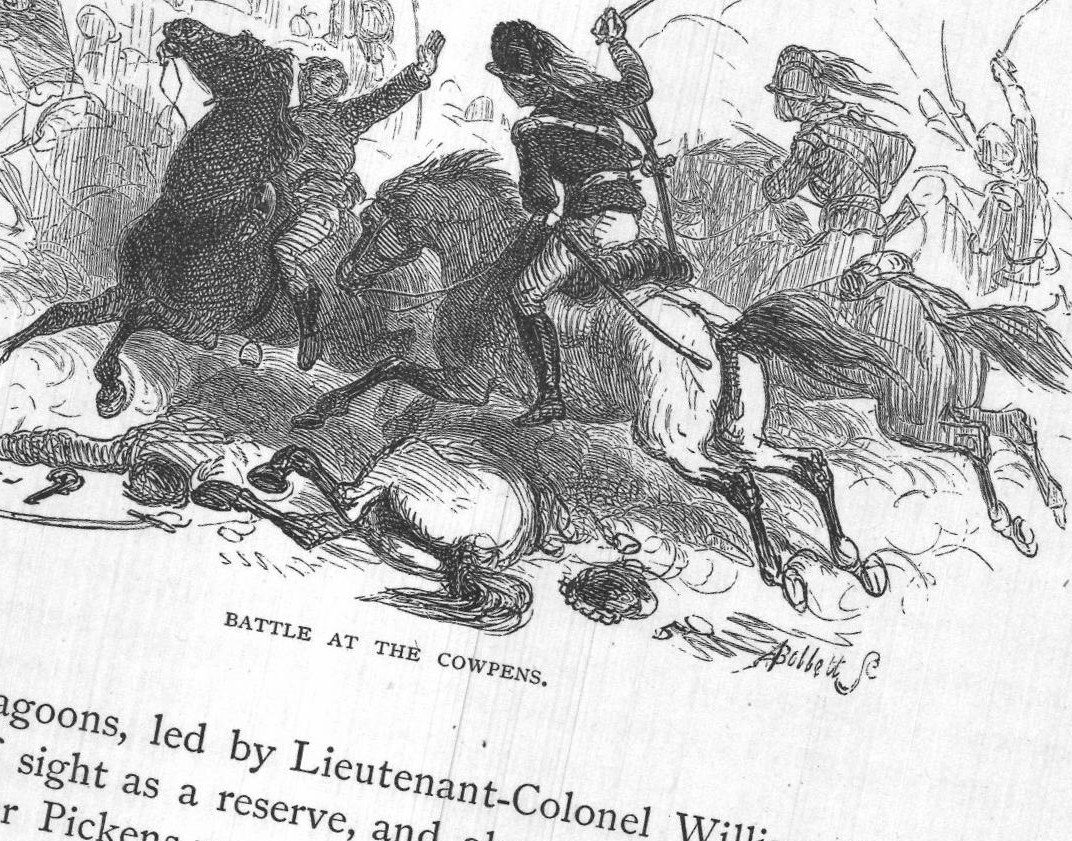
Such was the disposition of Morgan's little army when, at eight o'clock on the morning of the 17th of January, 1781, Tarleton, with eleven hundred troops, horse and foot, with two pieces of cannon, rushed upon the republicans with loud shouts. A furious battle ensued. In a skillful movement in the form of a feigned retreat, Morgan turned so suddenly upon his pursuers, who believed the victory was secured for them, that they wavered. Seeing this, Howard charged the British line with bayonets, broke their ranks, and sent them flying in confusion. At that moment Washington's cavalry suddenly broke from their concealment, and made a successful charge upon Tarleton's horsemen. The enemy was completely routed, and were pursed almost twenty miles in their eager flight. In this Battle of the Cowpens the Americans lost only seventy-two killed and wounded; the British lost over three hundred killed and wounded, and more than five hundred prisoners. The spoils were cannon, horses, wagons, eight hundred muskets, and two standards. The two cannon had been taken from the British at Saratoga, and were retaken by them at Camden. Tarleton's immense baggage, which he had left in the rear, was destroyed by his own men to prevent its being taken by the Americans. The Congress gave Morgan their thanks and a gold medal for his brilliant victory, and to Lieutenant-Colonels Howard and Washington each a silver medal.
At the close of the battle, Morgan pushed forward with his prisoners across the Broad River intending to pass the Catawba River and make his way toward Virginia. When Cornwallis heard of Tarleton's defeat, he started in pursuit of Morgan, with his whole army, as little encumbered with baggage as possible. He hoped to intercept the Americans at the fords of the Catawba, but he was too late. Morgan had crossed two hours before the arrival of the earl. Feeling sure of his prey, Cornwallis deferred crossing the river until morning. A heavy rain during the night swelled the stream to its brim, and he was kept back many hours. Meanwhile Morgan had reached the banks of the Yadkin, where he was joined by Greene. The latter, on hearing of the fight at the Cowpens, had left the camp at Cheraw in command of General Huger, and hastened to confer with Morgan. On the way he heard of the pursuit by Cornwallis, and sent back an order to Huger to break up the camp and join Morgan at Salisbury or Charlotte, in North Carolina. Cornwallis had been joined by troops from Camden under General Leslie; and at Ramsour's Mills (where, in June, 1780, North Carolina militia and a body of Loyalists had a sharp fight), he ordered all superfluous baggage and wagons to be destroyed. It was the 31st of January when Greene reached Morgan's camp on the Yadkin.
The wearied troops crossed the rising flood and found repose in the bosom of Halifax county, in Virginia. The earl, unable to cross the ford because of the high water, discomfited a third time by the elements, gave up the chase, turned his face southward, and moving sullenly back through North Carolina, established his headquarters at Hillsborough.