Home › King George and the Colonies › King George and the Colonies: Colonists
King George and the Colonies: Colonists
In spite of the protest of some really great men in England, who knew the Colonists were illtreated, the King went blindly and obstinately to work, until the Colonies in America were in complete revolt. To see how poorly the great mass of the people of England was represented in their Parliament, we should know that, when George III came to the throne, there was a most unequal distribution of seats in the House of Commons. For two hundred years, no changes had been made in the allotment of seats according to the number of the population.
Some very large cities, like Manchester and Sheffield, that had grown up in the meantime, had no representatives at all, while some very small and old places had several representatives. One town, named Old Sarum, went on sending members to Parliament long after it had ceased to have any inhabitants at all.
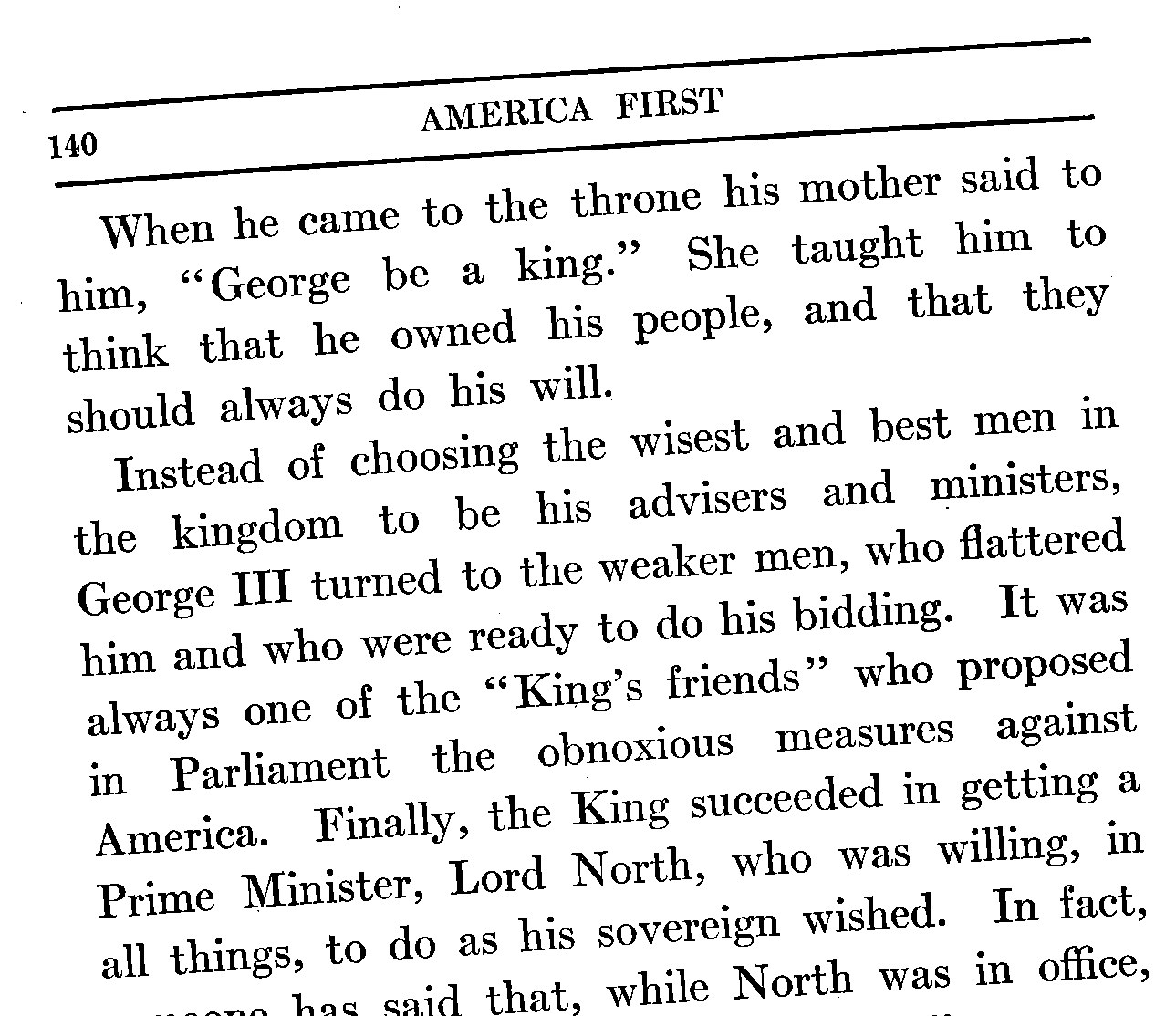
The result was that many members represented only a handful of voters, many seats in Parliament were bought and sold, and some were given away, as favors. This made an assembly of representatives that did not truly represent the great body of the people, and it, therefore, became easy for the King to secure such laws as he and his friends wanted. Was it not natural that a corrupt Parliament should do George III's own bidding? He united, with the ruling class, to suppress public opinion in England, and self-government in America. He began to rule the Colonies by royal orders, and sent instructions, over his own signature, to be obeyed in America; otherwise, so he threatened, military force would be used to make the people obey.
Colonial assemblies were dissolved, unusual places of meeting were appointed, orders were issued, lands were granted or taken away, and by many other acts the Colonists were treated without consideration.
But the Colonists had many friends among the English people, who sympathized with them in their opposition to the tyranny of the King and his Parliament. They were still English people and English subjects, though their home was across the sea, and they had rights that their relatives and friends in England thought should be respected.
So there were many in the old country who believed that the Colonists were right to oppose the King; some voices in Parliament even spoke out bravely in their defense.
One great Englishman, William Pitt, who was the Earl of Chatham, declared in the House of Lords, "This kingdom has no right to lay a tax upon the Colonies. I rejoice that America has resisted." After the Revolutionary War had begun, and the King had been forced to hire about 20,000 German troops from the Duke of Brunswick, because the English simply would not enlist for this unpopular war, Pitt said, in another speech, "My Lords, you cannot conquer America. In three years' campaign, we have done nothing and suffered much. You may swell every expense, accumulate every assistance you can buy or borrow, traffic and barter with every little pitiful German prince, but your efforts are forever vain and impotent, doubly so from this mercenary aid on which you rely, for it irritates to an incurable resentment. If I were an American, as I am an Englishman, while a foreign troop was landed in my country, I would never lay down my arms, - never, never, never."
While the Stamp Act was being debated in Parliament, Colonel Barré, who had fought by the side of Wolfe at Quebec, replied to the statement that the Colonies were children "planted by our care, nourished by our indulgence, and protected by our arms," by exclaiming with great eloquence, "They planted by your care! No, your oppression planted them in America. Nourished by your indulgence! They grew up by your neglect of them. They protected by your arms! Those sons of liberty have nobly taken up arms in your defense."
The expression, "Sons of Liberty," became a popular rallying cry of the Patriots in America.
The quarrel between King George III and the American Colonists grew into the Revolutionary War. During that War, the Colonists had many friends in England, especially in the city of London. As he walked through the streets, William Pitt was loudly cheered for the part he took in defending the cause of the Colonists. When the war was over, many in England were secretly rejoiced that the Colonies were independent, and that the will of the foolish King was at last broken.